Welding thin metal burns through easily because it heats up fast and has very little mass to absorb excess heat.
The solution is simple: lower your heat, weld in short bursts, and control the puddle carefully.
Whether you’re repairing automotive panels, fabricating HVAC ducting, or working with light-gauge steel, this guide shows you exactly how to weld thin metal without burning through.
We’ll cover the best welding methods, machine settings, and proven techniques that help you produce clean, strong welds without frustration.
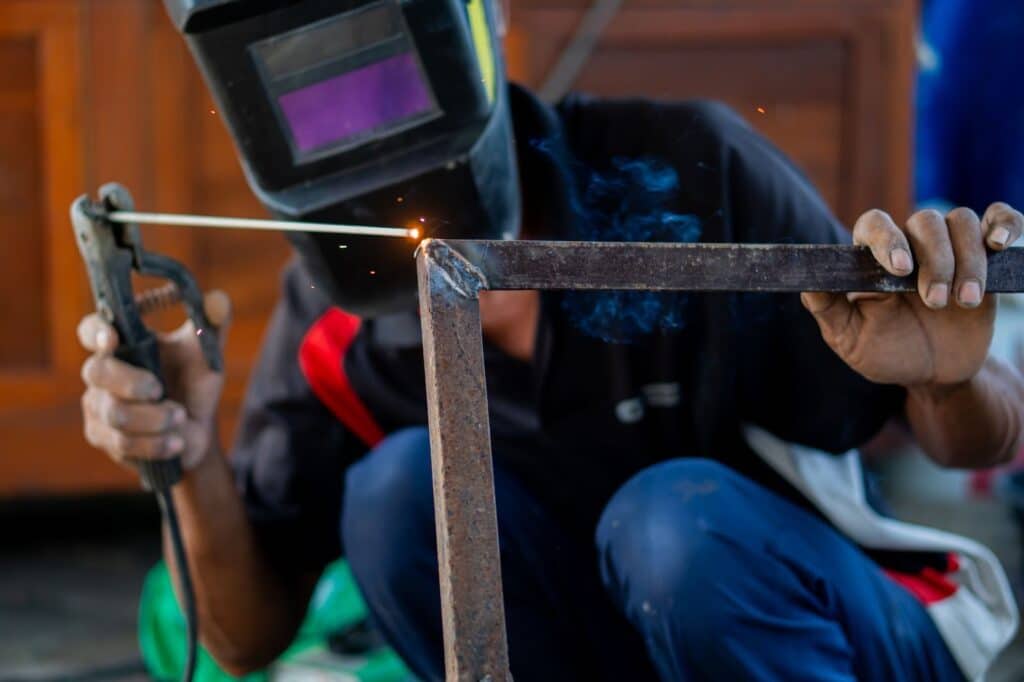
Why does Thin Metal Burn Through So Easily?
Thin metal burns through because it heats up faster than it can dissipate heat. With very little mass, even a brief pause in one spot can push the metal past its melting point.
In real-world welding, thin sheet metal (usually 18–22 gauge):
- Heats up almost instantly
- Cannot spread heat away from the weld zone
- Forms an unstable weld puddle
- Collapses into holes when overheated
This is why welding techniques that work fine on thick plate fail on thin material. Long beads, high voltage, and slow travel speeds simply dump too much heat into a small area.
That’s also why thin-metal welding requires a different approach. Instead of continuous welds, you need short bursts, lower heat settings, and deliberate cooling time.
Once you understand this behavior, the step-by-step techniques below start to make perfect sense.
How to Weld Thin Metal Without Burning Through (Step-by-Step)
You weld thin metal without burning through by using short welds, low heat settings, tight fit-up, and controlled travel speed instead of running long beads.
Below are the most reliable techniques used by professional fabricators and auto body welders.
1. Use the Stitch Welding Technique
Stitch welding prevents burn-through by limiting heat buildup in one area.
Instead of running a continuous bead:
- Weld for about ½ second
- Stop and let the metal cool
- Move to a different spot
- Repeat until the seam is complete
This method is also called skip welding or manual pulse welding. It’s the single most effective way to protect thin metal.
2. Tack Everything First
Tack weld the entire seam every 1–2 inches before welding anything solid.
This:
- Prevents gaps from opening
- Reduces heat distortion
- Holds panels in alignment
- Spreads heat evenly
Good fit-up makes thin-metal welding dramatically easier.
3. Use a Copper or Aluminum Backing Plate
Place a copper or aluminum bar behind the joint whenever possible.
This works because:
- Copper absorbs heat rapidly
- Weld metal does not stick to copper
- The backing plate supports the weld puddle
This trick is especially useful for automotive patch panels and sheet metal repairs.
4. Lower Your Heat Settings
Too much heat causes holes. Always start lower than you think you need.
- Lower voltage (MIG)
- Lower wire feed speed
- Lower amperage (TIG)
Increase slowly until the weld wets out cleanly.
5. Use Smaller MIG Wire
A smaller wire carries less current and runs cooler.
Best choice:
- 0.023″ solid wire
Avoid large wires like 0.035″ on thin sheet metal.
6. Increase Travel Speed
Moving too slowly overheats the metal.
Practice on scrap to:
- Keep a consistent arc length
- Move smoothly
- Avoid lingering in one spot
7. Pull the Weld, Don’t Push It
When MIG welding thin metal, always pull (drag) the gun.
Pulling:
- Reduces heat at the leading edge
- Keeps the puddle smaller
- Improves control
8. Avoid Long, Continuous Welds
Running a full bead across thin metal almost guarantees warping or burn-through.
Instead:
- Weld short sections only
- Skip around the panel
- Let each area cool before returning
- Fill in between tacks gradually
Think of it like zipping up a jacket—one small section at a time, not all at once.
9. Use Pulse Mode (If Your Machine Has It)
Pulse mode reduces average heat while keeping the weld puddle active.
Pulse welding helps by:
- Lowering overall heat input
- Reducing distortion
- Improving puddle control
- Making stainless steel and aluminum easier to manage
Many modern MIG and TIG welders include pulse settings, and they’re extremely useful for thin material.
10. Keep the Arc Length Short
A longer arc creates more heat and less control.
For MIG welding:
- Aim for about ⅜” stick-out with solid wire
- Up to ½” if you want a softer arc
For TIG welding:
- Keep the tungsten close to the puddle
- Maintain a stable arc without dipping
A short arc keeps temperatures lower and the weld more predictable.
11. Clamp the Metal Tightly
Loose or vibrating panels overheat faster and weld poorly.
Secure the workpiece using:
- Cleco fasteners
- Locking pliers
- Welding clamps
- Strong magnets
Tight fit-up improves heat control and produces cleaner welds.
12. Use a Hammer and Dolly to Relieve Heat Shrinkage
When a tack weld pulls the metal upward, lightly hammer-dolly it flat.
This technique:
- Relieves stress in the panel
- Controls distortion
- Keeps the surface flat
This is standard practice in automotive body repair and patch panel work.
13. Clean the Metal Thoroughly Before Welding
Dirty metal causes unstable arcs, excessive spatter, and overheating.
Always remove:
- Rust
- Paint
- Dirt
- Oil and grease
- Galvanized coatings (for safety)
Use a flap disc, wire brush, or solvent to prep the joint properly.
Clean metal welds are cooler, smoother, and more consistent.
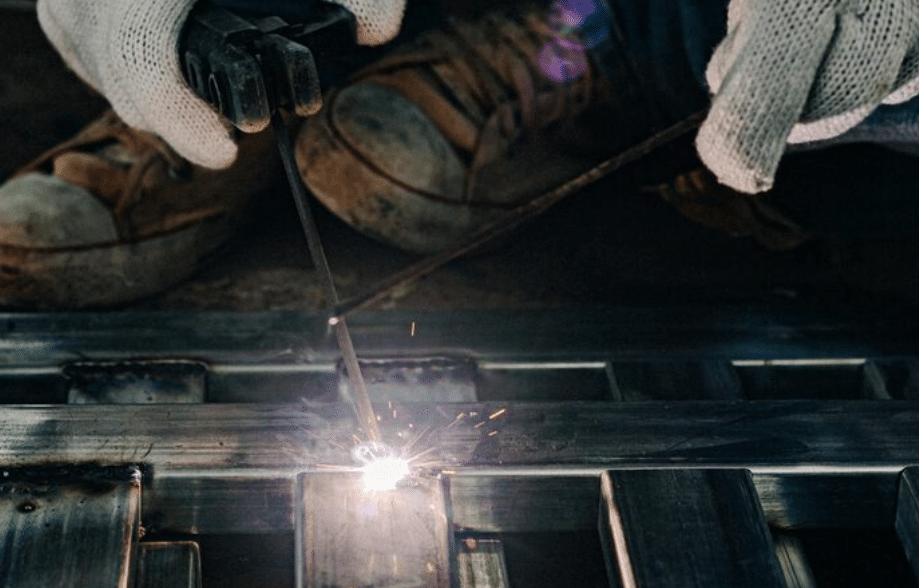
What Welding Settings Help Prevent Burn-Through?
The welding settings that prevent burn-through on thin metal all reduce heat input while keeping the arc stable. Lower voltage, smaller wire, faster travel speed, and controlled amperage matter more than raw power.
Below are the most effective setting adjustments, broken down by process.
- MIG Welding Settings to Prevent Burn-Through
MIG is the easiest process to control burn-through, as long as it’s set cold and stable.
Recommended MIG settings for thin metal:
- Wire Size: 0.023″ solid wire (most important setting)
- Voltage: Low, just high enough for proper fusion
- Wire Feed Speed: Moderate; avoid overpowering the puddle
- Transfer Mode: Short-circuit only
- Polarity: DCEP
- Shielding Gas: 75/25 Argon–CO₂
Why this works:
Smaller wire carries less current, lower voltage reduces arc heat, and short-circuit transfer keeps the puddle small and controllable.
If you’re blowing holes, lowering voltage almost always helps more than changing wire speed.
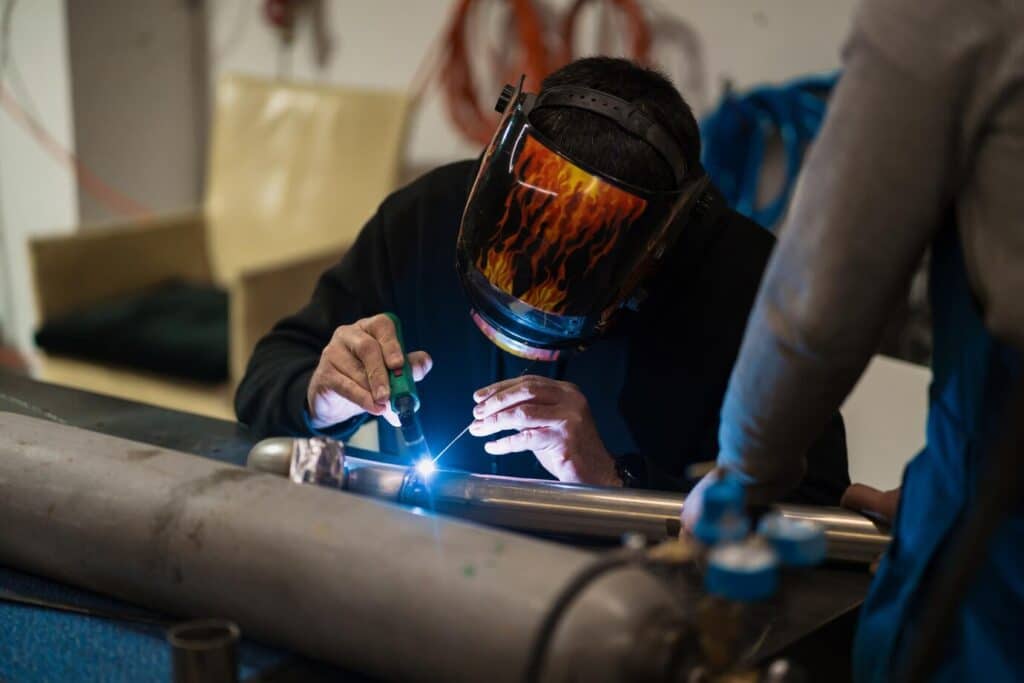
- TIG Welding Settings to Prevent Burn-Through
TIG gives the best heat control, but only if amperage is kept in check.
Recommended TIG settings for thin metal:
- Amperage Range: 30–60 amps (adjust by thickness)
- Shielding Gas: 100% Argon
- Tungsten: 1/16″ lanthanated or ceriated
- Pulse Mode: Use if available
- Foot Pedal: Strongly recommended
Why this works:
Lower amperage and pulse settings reduce average heat input, while the foot pedal lets you back off instantly when the puddle starts to collapse.
If the metal begins to glow, you’re already too hot.
- Travel Speed and Arc Control Settings
Machine settings alone won’t save thin metal if travel speed and arc length are wrong.
To reduce burn-through:
- Move quickly and steadily
- Avoid pausing in one spot
- Keep arc length short
- Do not weave the bead
A long arc and slow movement dump heat into one area—exactly what thin metal can’t handle.
- Heat-Control Aids That Act Like “Settings”
Some tools effectively lower heat input even without touching the machine.
- Copper or Aluminum Backing Bars: Pull heat away and support the puddle
- Pulse Mode: Lowers the average heat while keeping fusion
- Stitch Welding: Limits heat buildup better than any setting change
These techniques are often more effective than increasing or decreasing amperage alone.
Quick Burn-Through Prevention Settings Checklist
Use this checklist before you strike an arc on thin metal.
| Setting | Recommended |
| Wire Size (MIG) | 0.023″ Solid Wire |
| Voltage / Amperage | Low — Start Cold |
| Transfer Mode (MIG) | Short-Circuit |
| Travel Speed | Fast and Steady |
| Arc Length | Short |
| Pulse / Foot Pedal | Use If Available |
| Backing Bar | Copper or Aluminum |
Reminder:
If burn-through keeps happening, stop welding and reset your machine. Adding more heat rarely fixes the problem.
Burn-Through Causes & Quick Fixes
Burn-through almost always happens when too much heat stays in one spot for too long. The right fix depends on how the hole forms, not just on machine settings.
- Holes form immediately:
The heat is set too high. Lower voltage or amperage first, and start the weld on a tack instead of bare metal to soften the initial heat. - The metal looks fine, then suddenly collapses:
Heat is stacking up. Increase travel speed, weld in shorter bursts, and move to cooler areas before returning. - Burn-through appears at gaps or edges:
Fit-up is poor. Tighten the joint, add more tack welds, or use a copper backing bar to support the puddle. - Burn-through keeps happening across the panel:
The setup is likely wrong. Switch to a smaller wire (0.023″), shorten arc length, and avoid weaving the bead.
Tip: If the panel is getting hot to the touch, stop welding and let it cool. Thin metal does not recover once it overheats.
Reset order when things go wrong:
Lower heat → shorten weld time → increase travel speed → add tacks → use a backing bar.
Conclusion: How to Stop Burn-Through on Thin Metal
Burn-through isn’t a skill problem—it’s a heat control problem. Thin metal fails when heat builds faster than the material can absorb it, not because you lack experience.
Once you focus on controlling heat instead of forcing the weld, thin metal becomes far more predictable, even on delicate automotive panels and light-gauge steel.
For a full, fabrication-focused guide that covers warping, joint types, and material selection, see our Welding Sheet Metal: A Professional Guide for Fabrication.
If you’re refining your setup, YesWelder offers welder options designed for low-heat control on thin metal and sheet metal projects, making it easier to match your machine to your material and experience level.
FAQs: Welding Thin Metal Without Burn-Through
Yes. Small burn-through holes can be repaired by letting the area cool completely, backing the hole with copper, and filling it using short tack welds. Grinding gently between tacks helps avoid thinning the surrounding metal even more.
Absolutely. Thin metal below 18 gauge is far less forgiving than thicker sheet. As thickness drops, heat control becomes more critical, and even small pauses in one spot can cause failure.
The start of a weld concentrates heat into cold metal with no existing weld mass to absorb it. Beginning on a tack weld or easing into the puddle reduces that initial heat shock.
It can. Rust, paint, oil, or coatings disrupt arc stability and concentrate heat unevenly. Clean metal allows smoother heat flow and makes burn-through easier to control.
Yes. Zinc coatings interfere with arc stability and increase heat concentration once burned off. Always grind away galvanizing before welding and use extra care with heat control.