If you’ve ever chipped off slag and noticed tiny holes or hairline fractures in your weld bead, you know how frustrating SMAW defects can be. One minute, the weld looks fine, and the next, you’re grinding everything back out.
Stick welding (SMAW) is tough, versatile, and ideal for outdoor jobs. But because it’s manual and often done in windy, cold, or dusty environments, small changes in settings or technique can quickly lead to defects.
In this guide, we’ll explain why SMAW weld defects happen, how to diagnose them quickly, and what you can adjust to fix porosity, slag inclusions, and cracks. We’ll also walk through practical steps that help prevent these problems before they start. Let’s break it down step by step.
Why Do SMAW Weld Defects Happen?
SMAW defects almost always trace back to heat control, contamination, or hydrogen management.
Because stick welding is manual, you control amperage, arc length, travel speed, and electrode angle in real time. Even slight changes affect penetration, shielding, and cooling rate. Welding is predictable. If something goes wrong, a setting or condition changed.
Low amperage often causes a lack of fusion. Excessive amperage increases spatter and raises cracking risk. Electrode choice also matters more than many welders realize.
An E6013 rod behaves very differently from a low-hydrogen E7018 in penetration profile and slag behavior. A long arc weakens shielding and invites porosity. Surface rust, oil, paint, or moisture introduces gas into the weld pool. And damp electrodes introduce hydrogen, which may not show up until hours later as delayed cracking.
When weld quality drops, it’s rarely random. The weld is reacting to something.
Quick Diagnosis: What’s Wrong With Your SMAW Weld?
Before grinding everything out, identify the symptom.
Here’s a fast reference:
- If You See Small Holes In The Bead: You’re likely dealing with porosity caused by moisture, contamination, or unstable arc length.
- If Slag Won’t Separate Between Passes: You’re likely facing slag inclusions due to low heat, poor angle, or fast travel speed.
- If Cracks Appear After Cooling: You may have hydrogen-induced cracking or excessive cooling stress.
- If The Weld Looks Cold And Sits On Top: That suggests a lack of fusion from low amperage or improper technique.
Now let’s go deeper into each defect.
How Can You Fix Porosity In SMAW Welds?
Porosity Overview
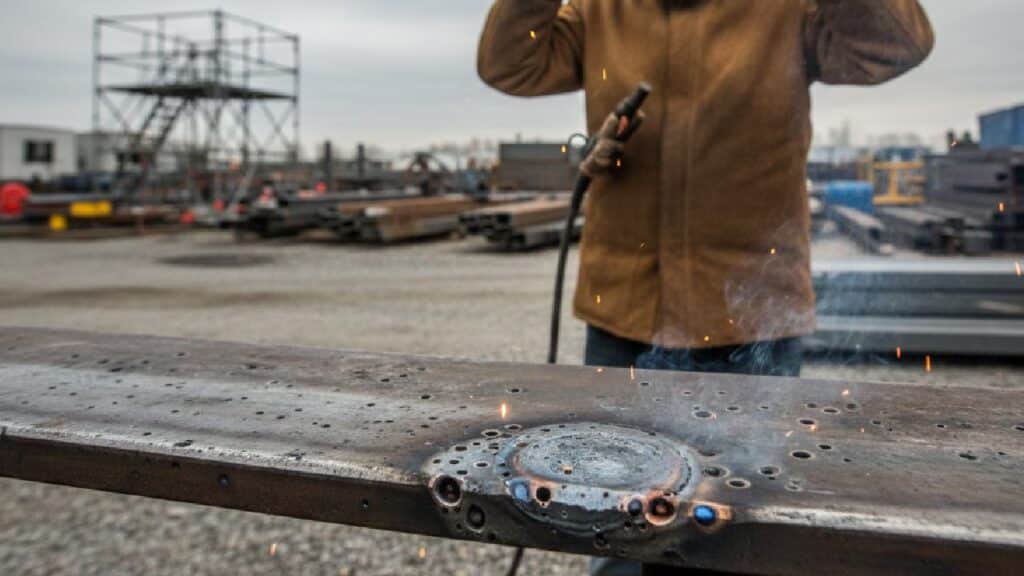
Porosity is trapped gas inside the weld metal. It appears as surface pinholes or internal voids.
It forms when gases like hydrogen, nitrogen, or oxygen cannot escape before the molten metal solidifies.
Root Causes of Porosity
The most common causes include:
- Moist Electrodes: Hydrogen gas forms when damp rods burn.
- Contaminated Surface: Oil, rust, paint, or moisture creates gas.
- Excessive Arc Length: Weak shielding coverage.
- Incorrect Amperage: Unstable arc traps gas.
- Rapid Cooling: Gas doesn’t have time to escape.
Low-hydrogen rods like E7018 reduce this risk — but only if stored properly in rod ovens (typically 250–300°F holding temperature).
Corrective Actions
Follow these steps:
- Clean The Base Metal Thoroughly: Use a grinder or a wire brush.
- Store Electrodes In Dry Conditions: Keep low-hydrogen rods heated.
- Maintain Short, Stable Arc Length: Avoid long arcs.
- Set Correct Amperage: For example, 3.2mm E7018 typically runs around 90–130 amps (check manufacturer specs).
- Control Travel Speed: Give gas time to escape.
If you’ve ever switched to a fresh, dry rod and the problem disappeared, you’ve already seen how moisture impacts weld quality.
Why Do Slag Inclusions Occur in SMAW Welds?
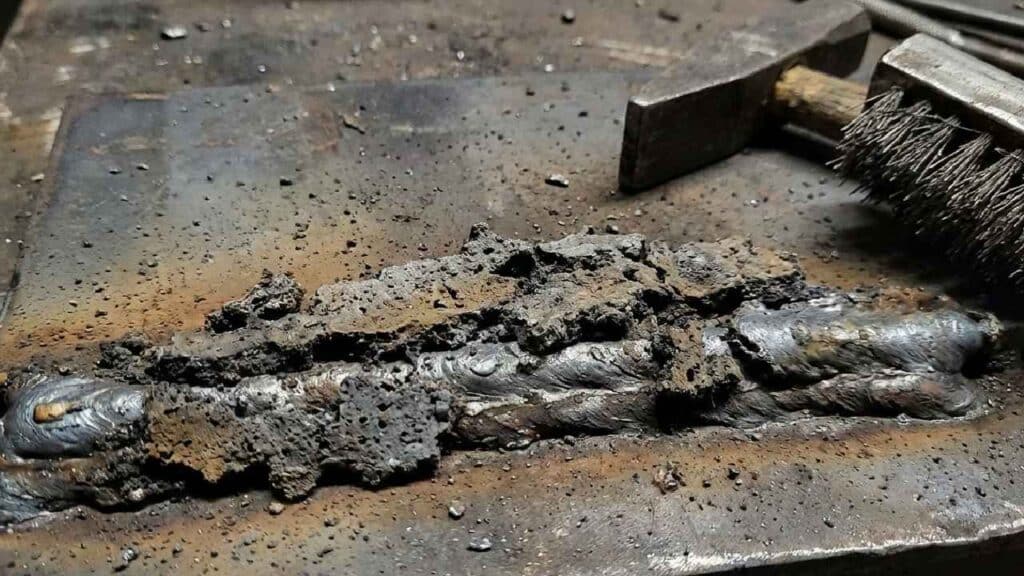
Slag Inclusion Definition
Slag inclusion refers to non-metallic residue that becomes trapped inside the weld metal or between weld passes.
While slag plays an important role in shielding the molten pool during welding, it must fully separate and be removed before the next pass. If it remains trapped, it creates weak points within the joint that reduce strength and fatigue resistance.
Common Causes of Slag Inclusions
Slag inclusion usually results from:
- Poor Interpass Cleaning: Slag left between passes.
- Low Welding Current: Insufficient heat prevents slag separation.
- Incorrect Electrode Angle: Slag fails to float upward.
- Fast Travel Speed: Slag gets trapped before rising.
- Tight Joint Design: No escape path.
Corrective Actions for Slag Inclusions
- Clean Slag Completely Between Passes: Use a chipping hammer and wire brush.
- Increase Heat Slightly If Needed: Ensure proper fusion.
- Adjust Electrode Angle: Maintain proper drag or push technique depending on rod type.
- Slow Down Travel Speed: Allow slag to rise.
- Improve Joint Prep: Open groove angles for better access.
If slag is consistently trapped at the toe of the weld, check your angle first.
Why Do Cracks Form In SMAW Welds?
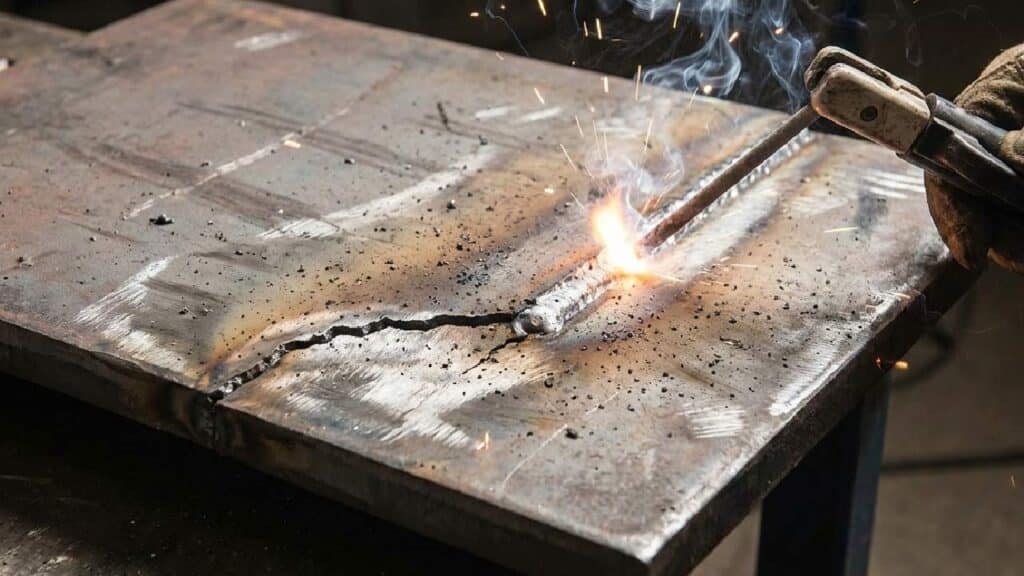
Types of Weld Cracks
Weld cracks are fractures that form either in the weld metal itself or in the surrounding heat-affected zone (HAZ). Unlike porosity or slag inclusions, cracks directly threaten structural integrity because they create a clear separation within the joint.
Cracks typically appear as:
- Hot Cracks (during solidification)
- Cold Cracks (after cooling)
- Crater Cracks (at weld termination)
Primary Causes of Cracking
Cracking usually results from:
- High Cooling Rate: Rapid cooling increases internal stress.
- Hydrogen Contamination: Moisture introduces hydrogen.
- Excessive Heat Input: Creates brittle structures.
- Poor Joint Design: Restricts contraction.
- Lack of Preheating: Cold base metal increases thermal shock.
Hydrogen-induced cracking is especially common in high-strength steel.
Preventive and Corrective Measures
- Preheat The Base Metal: Depending on thickness and material (often 150–250°F for thicker sections).
- Use Low-Hydrogen Electrodes: Such as E7018.
- Control Heat Input Carefully: Avoid excessive amperage.
- Fill Craters Properly: Avoid leaving crater cracks at weld termination.
- Perform Post-Weld Heat Treatment If Required: Reduce residual stress.
Cracks often appear hours after welding — so inspect again once the weld cools.
What Should You Check First When Defects Appear?
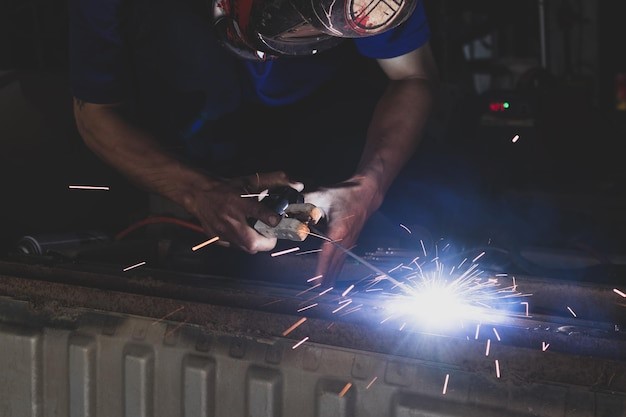
When a weld goes wrong, don’t adjust everything at once. Work through these steps in order and change one variable at a time.
- Inspect Surface Cleanliness:
Remove rust, oil, paint, mill scale, and moisture completely. Even light contamination can introduce gas into the weld pool and cause porosity. - Confirm Electrode Type And Storage:
Make sure the rod matches the material and application. Low-hydrogen electrodes such as E7018 must be kept dry. Damp rods are a common cause of delayed cracking. - Verify Amperage Settings:
Check the manufacturer’s recommended range for your electrode size. Low current reduces fusion. Excessive current increases spatter and brittleness. - Evaluate Arc Length:
Maintain a short, consistent arc. A long arc weakens shielding and increases instability. - Adjust Travel Speed:
Move slow enough for proper fusion and slag separation, but not so slow that excessive heat builds up. - Review Joint Design And Preparation:
Ensure the groove angle allows proper access and cleaning between passes. Tight joints often trap slag. - Assess Environmental Conditions:
Protect the weld from wind, moisture, and extreme cold. These factors affect shielding and cooling rate.
Most SMAW defects can be traced back to one of these seven checkpoints. If you follow them in sequence, troubleshooting becomes systematic instead of guesswork.
How Can You Reduce Defects Long Term?
Preventing defects is easier than repairing them. Once your fundamentals are consistent, porosity, slag inclusions, and cracking become far less common.
- Choose Appropriate Base Materials: Low-carbon steels are generally more forgiving than higher-strength alloys. When working with thicker or high-strength materials, control the cooling rate and hydrogen more carefully.
- Store Electrodes Properly: Keep low-hydrogen rods dry at all times. Moisture control is one of the most effective ways to reduce cracking risk.
- Maintain Stable Welding Technique: Keep arc length consistent and travel speed steady. Most defects appear when the technique becomes inconsistent under fatigue or time pressure.
- Avoid Excessive Heat Input: Overwelding increases distortion and residual stress. Balance penetration with controlled heat.
- Prepare Joints Carefully: Proper groove angle and thorough interpass cleaning prevent slag entrapment and incomplete fusion.
- Protect The Work Area: Shield outdoor welds from wind and moisture. Environmental exposure directly affects shielding and cooling behavior.
Stick welding rewards discipline. Small improvements in preparation and consistency prevent most defects before they start.
Final Thoughts: Mastering SMAW Weld Quality
Most SMAW weld defects trace back to three fundamentals: heat control, cleanliness, and hydrogen management. When one of these drifts, the weld responds immediately.
Porosity often signals contamination. Slag inclusions usually point to heat or technique. Cracks relate to cooling rate and hydrogen control, especially in thicker or higher-strength materials. The defect may look different, but the underlying causes are rarely random.
Approach troubleshooting methodically and adjust one variable at a time. Welding is predictable when the fundamentals are controlled.
Master the basics, stay consistent, and defect-free welds become the standard rather than the exception.
Frequently Asked Questions About SMAW Weld Defects
Hydrogen-induced cracking is often delayed because hydrogen diffuses through the weld metal as it cools. As the metal contracts, internal stress increases. If hydrogen is trapped in the structure, small cracks may form hours after the weld appears complete. This is why inspection after full cooling is critical, especially in structural applications.
Thicker plates cool more slowly on the surface but create higher internal restraint as they contract. That restraint increases stress in the weld zone. Without proper preheat, thicker materials are more prone to hydrogen cracking. As thickness increases, controlling heat input and preheat temperature becomes more important.
Yes. If the interpass temperature is too low, cooling stress increases between passes. If it is too high, excessive heat buildup may weaken mechanical properties. Maintaining a controlled interpass temperature helps balance stress and metallurgical structure, particularly in multi-pass welds.
Electrode diameter influences heat input and penetration profile. Larger electrodes require higher amperage and may increase heat buildup if not controlled properly. Smaller electrodes allow more precise control in thinner materials. Using the correct diameter for the joint thickness helps reduce lack of fusion and cracking.
The preheat temperature should be increased when welding thicker sections, higher-strength steels, or materials with higher carbon content. These materials are more sensitive to hydrogen and rapid cooling stress. Always follow material specifications or welding procedure requirements when determining preheat levels.