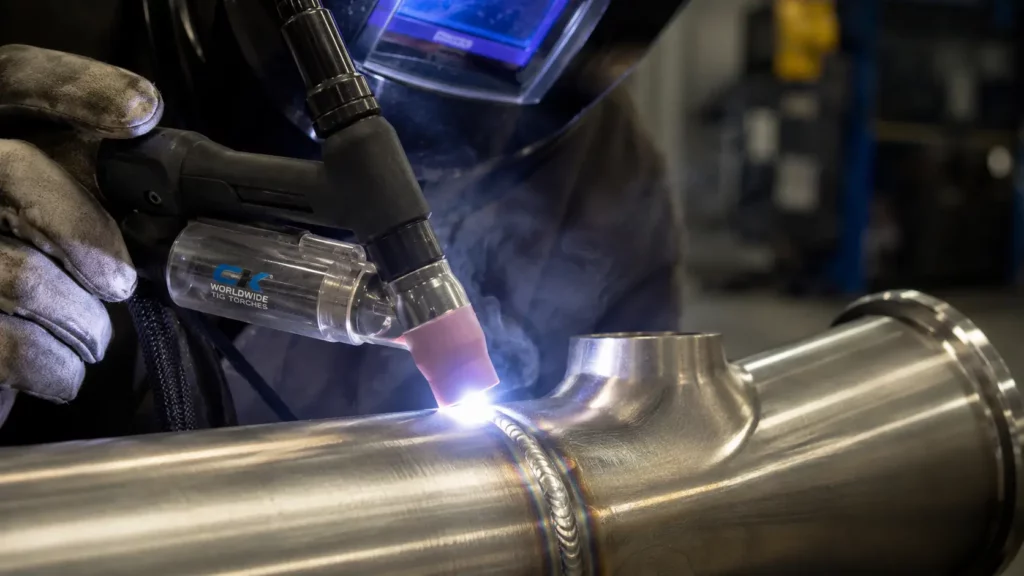
Welding titanium alloys is mainly about keeping hot titanium clean and protected. Once titanium gets hot, air, moisture, oil, or steel dust can contaminate the weld and make it brittle, even if the bead looks smooth.
In this guide, we’ll cover how to prepare titanium, choose the right welding process, set up argon shielding, read weld color, and avoid the mistakes that cause rejected welds.
Why Is Welding Titanium Alloys More Demanding Than Welding Ordinary Metals?
Titanium is harder to weld than ordinary steel because hot titanium reacts quickly with air. If oxygen, nitrogen, or hydrogen enters the weld area, the joint can become brittle, discolored, or more likely to crack later.
That is why titanium welding depends so much on cleaning and shielding. You are not only controlling the arc. You are also protecting the weld pool, filler wire, heat-affected zone, and cooling bead from contamination.
High-Temperature Reactivity and Contamination Risk
Steel can often tolerate light surface oxidation. Titanium usually cannot. Once titanium gets hot, poor gas coverage can let atmospheric gases enter the metal and reduce ductility, corrosion resistance, and fatigue strength.
This is why titanium welds need stable argon shielding during welding and enough gas coverage while the weld cools.
Oxygen, Nitrogen, and Hydrogen as the Three Main Threats
The 3 main contamination risks in titanium welding are:
- Oxygen Contamination: Oxygen comes from air, moisture, or poor shielding. It can make the weld brittle and reduce corrosion resistance.
- Nitrogen Contamination: Nitrogen can form hard titanium nitrides, which make the weld less ductile.
- Hydrogen Contamination: Hydrogen often comes from moisture, oil, dirty filler wire, or poor storage. It can cause porosity and delayed cracking.
All 3 can come from a normal shop environment. That is why titanium welding needs clean handling, dry filler wire, and complete gas coverage.
How Should Titanium Be Prepared Before Welding?
Prepare titanium for welding by cleaning the joint, separating titanium tools from steel tools, storing filler wire correctly, and welding soon after cleaning.
A clean weld starts before you strike the arc. Titanium is not forgiving here. If the part picks up oil, dust, steel particles, or moisture after cleaning, the weld can still fail your color check or quality inspection.
Use a Dedicated Titanium Work Area
Use a dedicated titanium welding area whenever possible. Keep it away from carbon steel grinding, cutting, and brushing work.
For titanium prep, use:
- Dedicated Brushes: Use stainless steel brushes that are reserved only for titanium.
- Dedicated Grinding Wheels: Do not use wheels that have touched carbon steel.
- Clean Fixtures: Keep the workbench, clamps, and backing bars free from steel dust.
- Separate Consumable Storage: Store titanium filler wire in a dry, sealed container.
One note: “titanium-only brush” means the brush is used only on titanium. It does not mean the brush itself must be made of titanium.
Follow a Simple Cleaning Sequence
Clean titanium joints as close to welding time as possible:
- Degrease the Joint Area: Use acetone or an approved solvent to remove oil and residue.
- Wipe the Surface Dry: Use a clean, lint-free cloth. Do not let solvent sit inside the joint gap.
- Remove Oxide If Needed: Use a dedicated stainless steel brush or approved abrasive that has only touched titanium.
- Wear Clean Gloves: Do not touch cleaned titanium with bare hands.
- Weld Soon After Cleaning: Do not clean parts today and weld them tomorrow unless you can protect them from dust and moisture.
Common Sources of Recontamination and Handling Errors
- Bare hand contact after cleaning
- Compressed air with oil contamination blown across the joint
- Filler wire pulled from uncontrolled storage with moisture or surface oxidation
- Cleaning solvents that leave residue if not fully wiped
- Shared grinding wheels that transfer carbon steel particles
Which Welding Processes Work Best for Titanium Alloys?
TIG/GTAW is the most common choice for titanium alloy welding because it gives you strong control over heat, filler wire, and argon shielding.
Other processes can work too, including plasma arc, laser, and electron beam welding. The deciding factor is not only heat input. The process also needs to protect the weld pool, the cooling bead, and the backside of the joint from air.
TIG/GTAW as the Standard Process for Titanium Welding
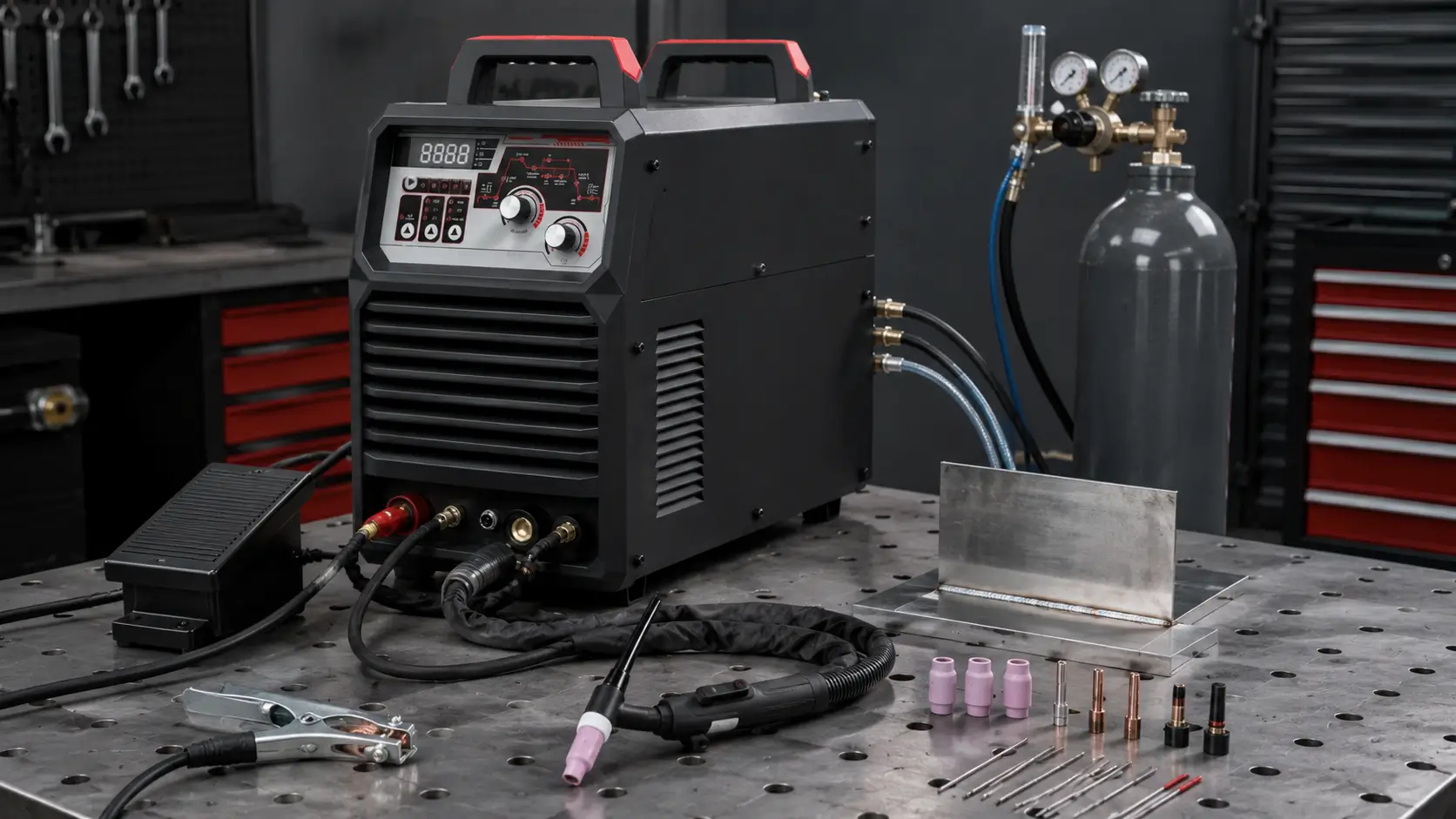
TIG welding (GTAW) is the default choice for quality-critical titanium work. It produces a low, controllable heat input, allows the welder to manage filler wire addition precisely, and is compatible with trailing shield and backside purge setups.
A well-configured TIG welder with high-purity argon shielding, post-flow control, and a trailing shield attachment covers the majority of titanium fabrication scenarios, from aerospace brackets to chemical process components.
TIG does require skilled operators. The torch angle, travel speed, and filler wire dipping technique all affect the quality of the shielding envelope around the weld pool. Inconsistent technique widens the shielding gap and allows contamination even with correct gas setup.
Plasma Arc Welding for Higher-Energy Applications
Plasma arc, laser, and electron beam welding are more specialized options:
- Plasma Arc Welding: Works well for thicker titanium parts or higher-volume production, but it needs tighter setup control than TIG.
- Laser Welding: Produces a narrow heat-affected zone and works well for precision parts.
- Electron Beam Welding: Uses a vacuum chamber, so it offers excellent atmospheric protection, but it is not practical for normal shop work.
For most fabrication shops, TIG is still the practical choice. It is easier to set up, easier to control, and easier to match with trailing shields and purge systems.
Inert Chambers and Glove Boxes
For the most contamination-sensitive titanium parts, such as aerospace primary structures or implant-grade medical components, welding may be done inside an inert chamber filled with argon or helium. The operator works through glove ports, so the hot metal stays away from normal shop air.
This method gives the strongest contamination control, but it is expensive and not practical for most field or job-shop work.
Alloy Type and the Welding Window
Not all titanium alloys respond to welding heat the same way. Commercially pure titanium grades are usually the easiest to weld because they tolerate a wider process window.
Ti-6Al-4V, also called Grade 5 titanium, is weldable but less forgiving. It needs tighter control of heat input, interpass temperature, and shielding. Some high-spec applications may also require procedure qualification or post-weld heat treatment.
Titanium Welding Process Comparison
| Process | Best Use Case | Main Strength | Main Limitation |
| TIG/GTAW | Most quality-critical titanium work | Control, flexibility, shielding compatibility | Slower, operator-skill dependent |
| Plasma arc (PAW) | Thicker sections, higher production rate | Higher energy density, deeper penetration | More complex setup |
| Laser welding | Precision aerospace and medical components | Minimal heat input, narrow HAZ | High equipment cost |
| Electron beam | Maximum contamination-sensitive applications | Complete atmospheric exclusion (vacuum) | Vacuum chamber required, not portable |
What Shielding Gas Strategy Does Titanium Welding Require?
Titanium shielding is more than gas from the torch nozzle. In most open-air TIG setups, you need to protect 3 areas: the weld pool, the cooling bead, and the backside of the joint.
The goal is simple: any titanium surface that stays hot enough to react with air needs gas protection.
Why High-Purity Argon Is Treated as the Safe Baseline
Argon with a minimum purity of 99.995% (Grade 4.5 or better) is the standard shielding gas for titanium welding. Lower-purity argon contains enough residual oxygen and nitrogen to cause visible and subsurface contamination.
Helium or argon-helium blends are used in some applications for higher heat input, but argon remains the baseline for contamination-sensitive work. The MIG welder argon blends commonly used for stainless steel, with CO₂ additions, are not acceptable for titanium under any circumstances.
The Three-Zone Shielding Approach
A typical titanium shielding setup includes:
- Torch Shielding: Protects the active weld pool. A gas lens and larger cup can improve argon coverage.
- Trailing Shielding: Protects the freshly solidified bead while it is still hot enough to react with air.
- Backside Purge: Protects the root side of the joint when the backside is exposed to air.
In a chamber or glove box, the setup looks different, but the purpose is the same: keep hot titanium away from oxygen, nitrogen, and moisture.
Flow Rate, Post-Flow, and Cooling Protection
Keep post-flow running long enough for the weld and heat-affected zone to cool without discoloring. Thin parts may need only a short post-flow time, while thicker sections often need longer gas coverage.
On heavier sections this may mean 30 seconds or more of post-flow.
Premature gas cutoff produces a characteristic blue-to-grey surface discoloration on the weld end crater. Most quality welding equipment designed for TIG applications includes adjustable post-flow timers, verify this feature is set correctly before starting production work.
Common Signs That Shielding Has Already Failed
- Blue, purple, or grey weld surface color (covered in detail in the next section)
- Visible surface porosity or a rough, sandy texture on the bead surface
- White or chalky powder on or near the weld, this is severe and indicates complete oxidation
- Cracking in the weld or HAZ after cooling
How Do You Read a Titanium Weld Color Chart Correctly?
Titanium weld color helps you judge whether shielding worked. It is useful for quick screening, but it does not replace the required inspection standard.
Weld Color as an Indicator of Oxidation
Titanium changes color when hot metal reacts with oxygen. In general, brighter silver means better shielding, while blue, purple, grey, or chalky white suggests more oxidation.
The darker the color, the more carefully you should check the weld, the shielding setup, and the acceptance standard.
A Practical Titanium Weld Color Guide
| Color | Oxidation Level | Typical Acceptance |
| Bright silver / shiny metallic | Minimal — excellent shielding | Accepted for all applications |
| Light straw / pale gold | Very low — generally acceptable | Accepted in most applications |
| Dark straw / golden yellow | Low-moderate | Accepted in some non-critical applications |
| Blue (light to dark) | Moderate | Rejected for aerospace; review required for others |
| Purple / violet | Significant | Rejected for structural and critical use |
| Grey or chalky white | Severe — complete surface oxidation | Rejected for all applications |
Color as a Screening Tool, Not a Complete Acceptance Standard
Weld color screens the surface only. A bright silver bead can still contain internal porosity or hydrogen contamination not visible to the eye. Color assessment is the first filter. It eliminates obvious shielding failures immediately, but it does not replace dimensional inspection, NDT, or mechanical testing where those are specified.
Which Standards and Quality Checks Apply to Titanium Alloy Welding?
Acceptance Criteria Beyond Surface Appearance
Acceptance criteria for titanium welds typically cover surface color (using a documented color standard), dimensional conformance, surface porosity limits, and, for structural applications, mechanical property requirements from test coupons. Not every titanium weld requires full NDT, but the decision to omit it should be based on application risk, not convenience.
Common Standards and Reference Documents
Titanium weld acceptance depends on the part and the application. A simple shop part may only need visual inspection. Aerospace, pressure, medical, or structural parts may require procedure qualification, NDT, and mechanical testing.
Common checks include:
- Visual Inspection: Checks weld color, bead shape, surface oxidation, and visible defects.
- Dimensional Inspection: Confirms weld size, fit-up, and final tolerance.
- NDT: Helps find surface or internal defects when the application requires it.
- Mechanical Testing: Verifies strength, ductility, or procedure performance.
- Documentation: Records the WPS, welder qualification, filler material, gas purity, and inspection results.
Common reference documents include AWS G2.4 for titanium welding guidance, AWS D17.1 for aerospace fusion welding, and relevant AMS specifications for aerospace materials or filler metals.
Documentation, Inspection, and Verification
A complete quality package for titanium welding typically includes: an approved welding procedure specification (WPS), welder qualification records, material traceability for base metal and filler wire, shielding gas purity certificates, and inspection records. For non-aerospace fabrication, requirements are less stringent, but documenting the procedure used and the acceptance basis is still good practice.
What Common Mistakes Ruin Titanium Welds?
Most titanium weld failures come from small process mistakes, not one dramatic error.
Losing Protection During Cooling or on the Weld Backside
Do not stop shielding as soon as the arc ends. Titanium can still react with air while the weld is cooling. The root side also needs protection when it gets hot and is exposed to air.
Recontamination After Cleaning
Cleaning only works if the part stays clean. Do not touch cleaned titanium with bare hands, blow oily compressed air across the joint, or place it on a dirty steel workbench.
Excessive Heat Input and Grain Growth Risk
Too much heat can widen the heat-affected zone and reduce toughness, especially on alloys like Ti-6Al-4V. Control travel speed, interpass temperature, and heat input according to the WPS.
Conclusion
Titanium alloy welding is not about forcing more heat into the joint. It is about keeping the weld clean from start to finish. That means clean base metal, clean filler wire, stable TIG control, proper argon shielding, enough post-flow, and backside protection when the joint needs it.
If your welds are turning blue, grey, or chalky white, do not treat it as a cosmetic issue. Check your gas coverage, torch setup, purge method, and heat input before welding more parts.
For shops setting up titanium TIG welding, YesWelder can help you choose a practical welding machine and the right accessories for cleaner shielding, steadier arc control, and better weld consistency. Explore YesWelder’s TIG welding equipment or contact the team for setup guidance before your next titanium project.
Frequently Asked Questions
TIG/GTAW is the safer and more common choice for titanium welding because it gives you better control over heat and shielding. MIG/GMAW is not usually recommended for quality-sensitive titanium work unless the procedure, gas coverage, and application have been properly qualified.
Most titanium TIG welds do not need preheating in the same way some steels do. The bigger concern is keeping the joint clean, dry, and fully shielded. If a procedure calls for preheat, follow the WPS instead of guessing.
You can remove surface discoloration, but grinding does not automatically fix contamination inside the weld or heat-affected zone. Treat color as a warning sign first. Check the shielding setup, purge coverage, and acceptance standard before deciding whether the weld can stay.
Use high-purity argon for most titanium TIG welding jobs. Argon-helium blends may be used in some higher-heat applications, but never use active gas blends with CO₂ or oxygen for titanium.
Start with the basics: clean base metal, clean filler wire, dry gloves, a gas lens, enough post-flow, and proper backside protection. Most beginner problems come from contamination and poor shielding, not from the arc itself.
Yes, the same TIG machine can be used, but the work area, tools, brushes, filler wire, and shielding setup must be kept clean. Do not carry steel dust, dirty gloves, or contaminated grinding tools into titanium work.