Automotive welding in a repair shop is the controlled joining of vehicle metals during collision repair, rust repair, exhaust service, restoration, and custom fabrication. The right equipment mix usually includes a reliable MIG welder, selected TIG capability, spot weld access when OEM procedures require it, proper surface preparation tools, clamps, PPE, ventilation, and repeatable shop procedures.
For repair shops, the main question is not “Which welder is best?” The better question is “Which welding setup supports the work we do every week without slowing technicians down or creating repair quality risk?”
From there, the equipment choices become easier: match the work first, then choose the process, machine, accessories, PPE, and support package around it.
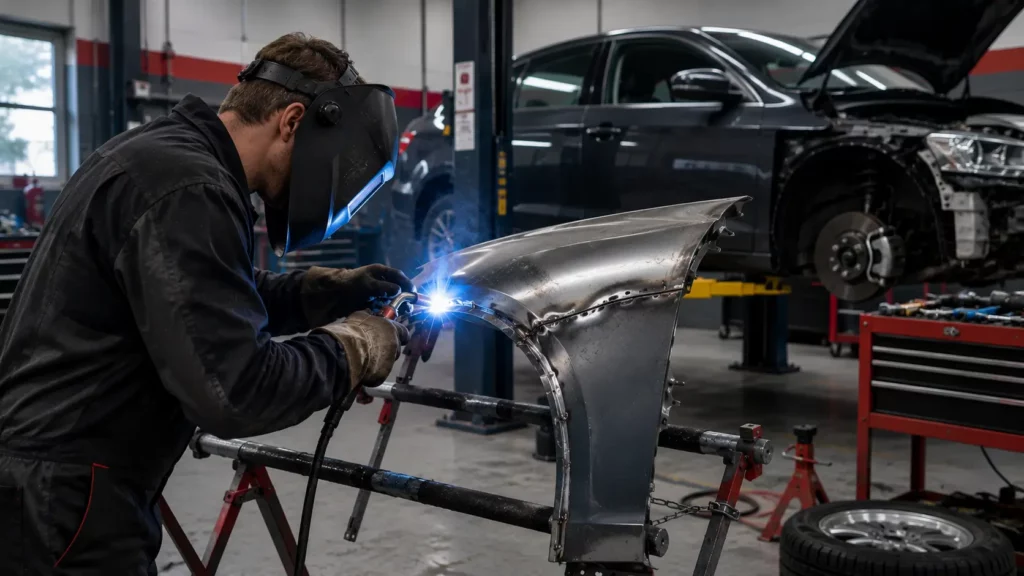
What Is Automotive Welding in a Repair Shop?
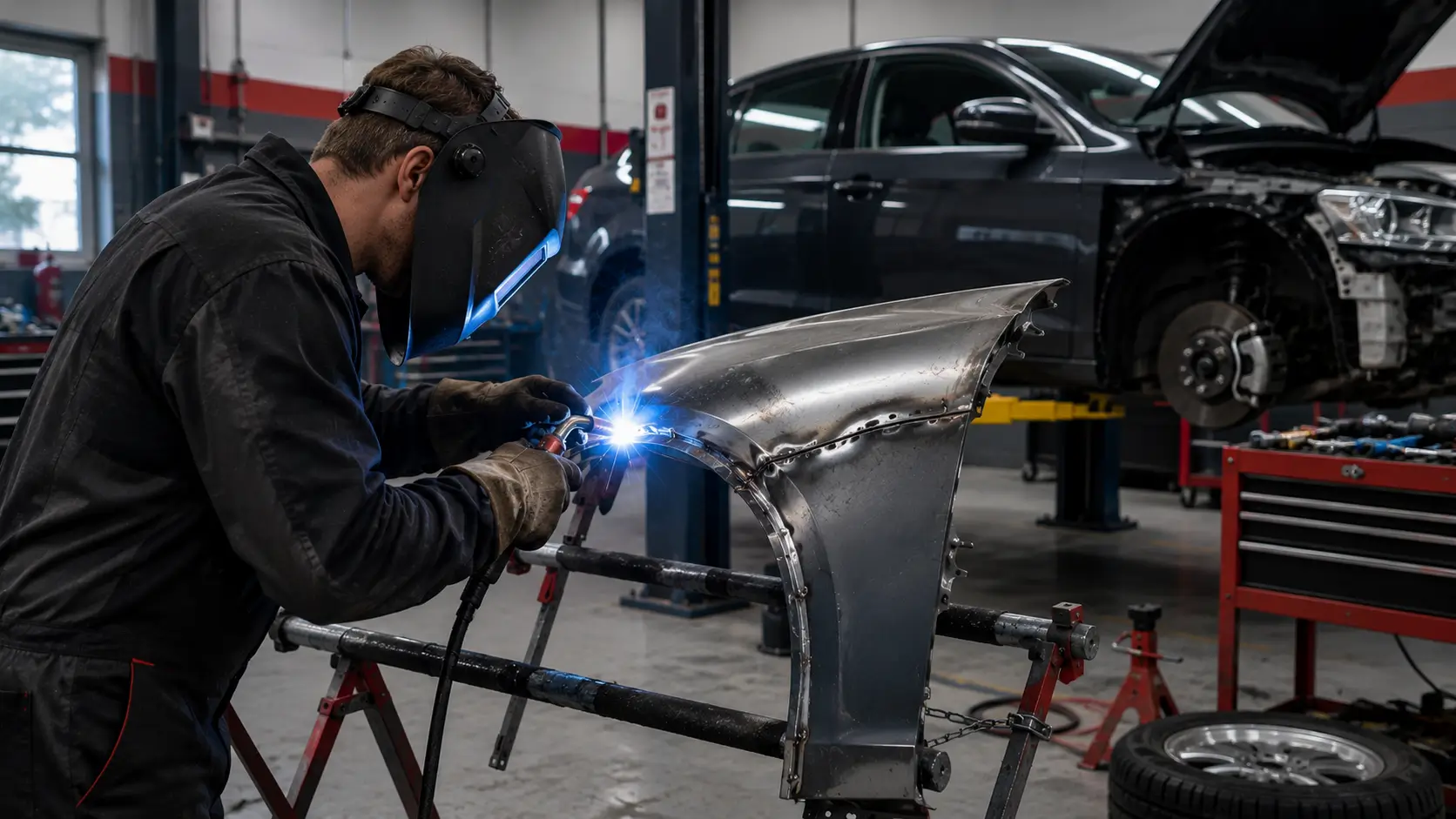
Automotive welding in a repair shop covers the welding and thermal joining work used to repair, modify, or restore vehicles. Unlike factory welding, which often uses robotic spot welding, laser welding, and controlled production fixtures, repair shop welding has to deal with damaged panels, rusted metal, coatings, limited access, mixed materials, and job deadlines.
That is why the repair work should lead the equipment choice. A shop repairing rusty floor pans does not need the same setup as a collision center replacing late-model structural panels.
| Repair Work | Common Welding Need | Equipment Direction |
| Collision and panel repair | Plug welds, short stitch welds, panel replacement | MIG welder, spot weld removal tools, clamps, PPE, and OEM procedure access |
| Rust repair and restoration | Thin sheet metal patches and low heat input | MIG with fine wire, careful fit-up tools, and TIG for selected specialty work |
| Exhaust service | Thin-wall steel, stainless tubing, hangers, and mufflers | MIG for speed, TIG for clean stainless work, tube tools, clamps, and fume control |
| Aluminum and specialty fabrication | Aluminum parts, visible welds, custom brackets, and motorsport work | AC TIG or aluminum-capable MIG, clean filler storage, dedicated prep tools, and technician training |
| Structural and OEM-directed repairs | OEM-defined welds on reinforcements, rails, pillars, and panels | Repair procedure access, approved joining method, test weld process, and documentation |
A clean weld is not always the right repair. Modern vehicle repair can involve squeeze-type resistance spot welding, MIG brazing, adhesive bonding, sectioning, or replacement instead of welding. Equipment choice should support the repair procedure, not override it.
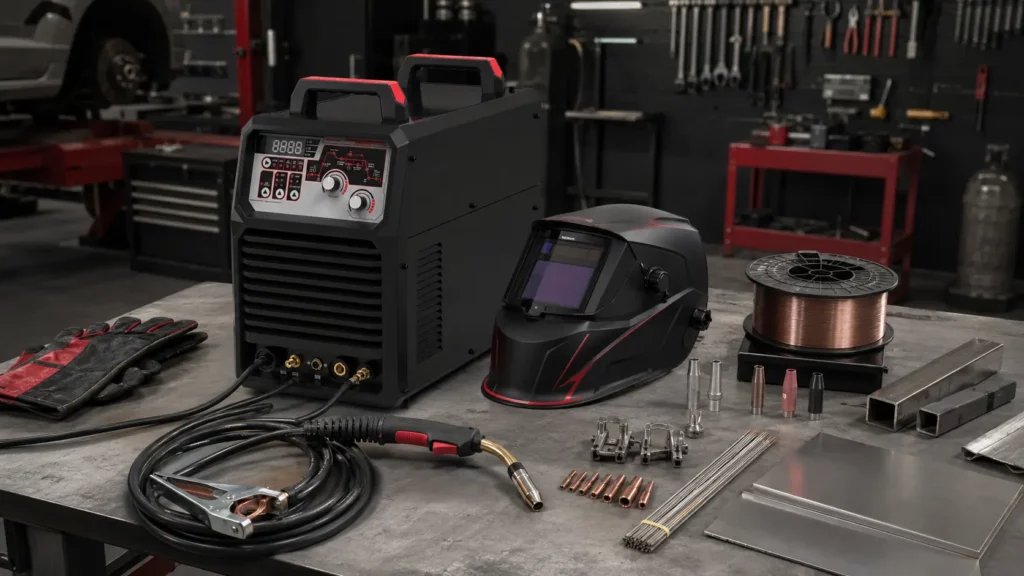
Which Welding Processes Fit Your Auto Repair Work?
Most repair-focused welding setups start with MIG, then add TIG, resistance spot welding, or MIG brazing capability when the service mix requires it. The right process depends on your materials, panel thickness, technician workflow, access around the joint, heat control needs, and OEM repair requirements.
MIG Welding for Daily Steel Repair
MIG welding, also called gas metal arc welding or GMAW, is the main arc welding process in many auto repair businesses because it is fast, teachable, and flexible. It fits common steel repair work such as patch panels, plug welds, brackets, hangers, and exhaust jobs.
For automotive steel, your repair shop needs a MIG welder that runs smoothly at low amperage. Thin sheet metal does not forgive excess heat, so the useful features are not only maximum output. Look for steady wire feeding, fine voltage and wire speed adjustment, torch access in tight spaces, and easy access to tips, nozzles, liners, and drive rolls.
For mild steel automotive repair, many shops use ER70S series solid wire with an argon and carbon dioxide shielding gas blend. Exact wire size and gas should follow the machine manual, repair procedure, and shop process.
TIG Welding for Stainless, Aluminum, and Custom Work
TIG welding, also called gas tungsten arc welding or GTAW, gives strong heat control and clean bead appearance. It is slower than MIG, but it earns its place when your repair shop handles stainless exhaust, aluminum parts, custom brackets, visible welds, motorsport work, or restoration jobs where fit-up and finish matter.
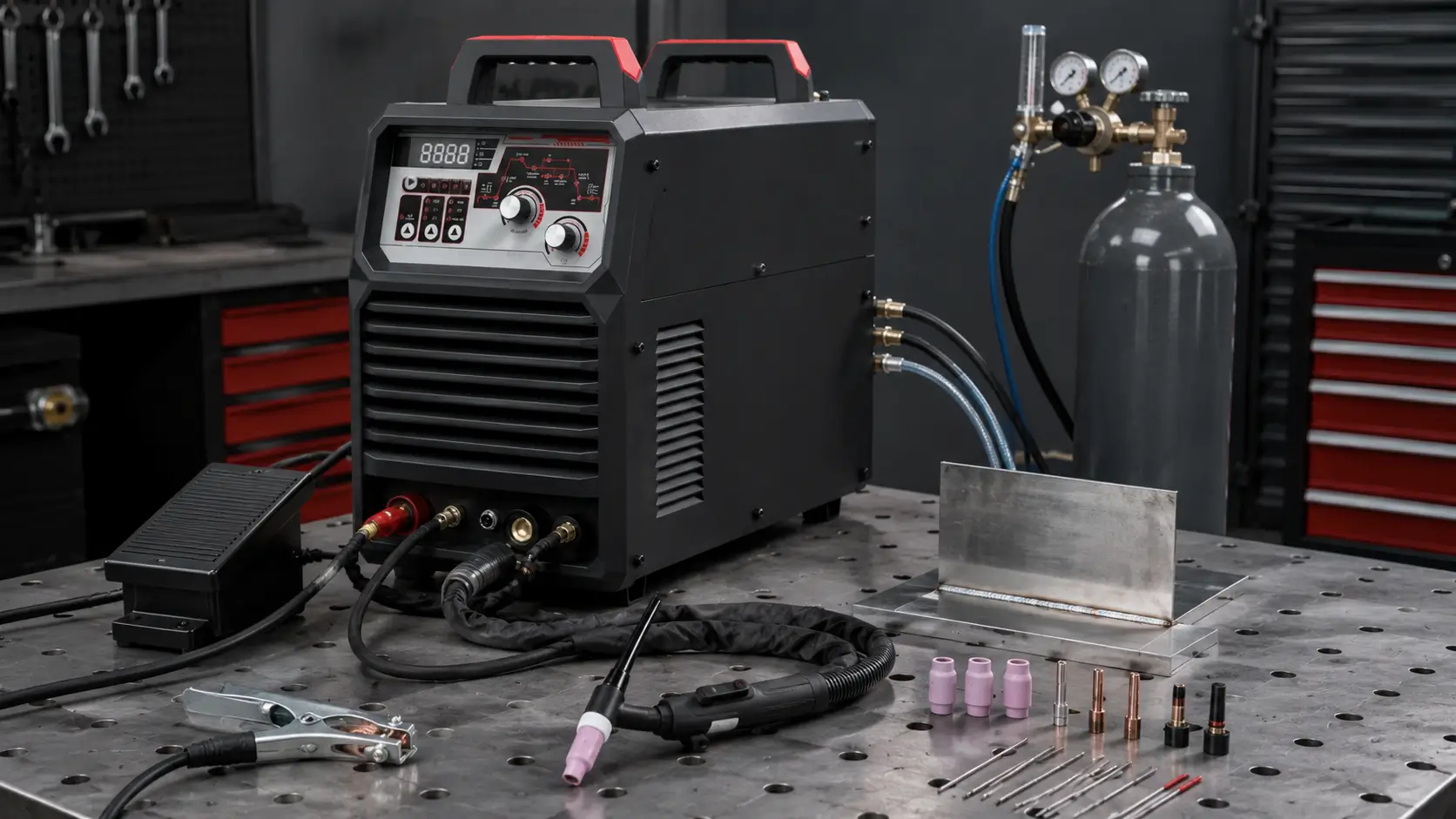
TIG also changes the equipment package. Your setup may need an AC/DC TIG welder for aluminum, DC TIG for steel and stainless, foot pedal or fingertip control, pulse control for thin material, torch options for tight spaces, clean filler storage, tungsten storage, and better work positioning.
TIG is not a replacement for MIG in daily repair flow. It is the process to add when precision, material type, or visible weld quality justifies the slower setup.
Resistance Spot Welding for Panel and Collision Work
Resistance spot welding joins overlapping sheet metal by clamping the joint between electrodes and passing current through the area. It is common in vehicle manufacturing and may be needed in repair work when the procedure calls for factory-style spot welds.
For your repair shop, the buying question is practical: does the service mix justify the cost, space, power, technician training, and service support for spot welding equipment?
A rust repair or restoration-focused setup may not need spot welding access right away. A collision-focused operation working on newer vehicles, panel replacement, or insurance jobs may need to plan for spot welding capability more seriously.
MIG Brazing When Lower Heat Is Required
MIG brazing uses a filler metal that melts at a lower temperature than steel. In automotive repair, it may be used when the repair information calls for lower heat input, especially around certain coated steels or modern body structures.
This is not a universal substitute for welding. Brazing-capable equipment does not mean your technicians can use MIG brazing on every panel. The setup still needs the correct wire, shielding gas, machine settings, technique, and technician practice.
For equipment planning, MIG brazing matters because it may affect machine mode, wire stocking, gas setup, technician training, and documentation before your shop offers that repair.
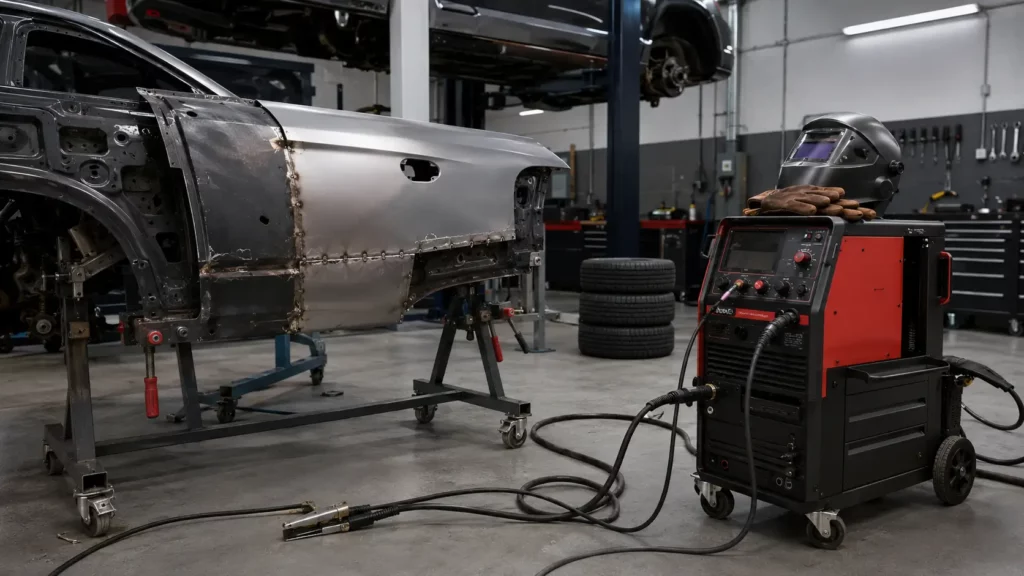
What Equipment Setup Should Support That Work?
A good automotive welding setup is not only the power source. Your repair shop needs the machine, torch access, prep tools, clamps, consumables, PPE, ventilation, and spare parts to work together around daily repair jobs.
| Setup Area | What to Include | Why It Helps |
| Welding machines | MIG equipment first, then TIG, spot welding, or MIG brazing capability when the work requires it | Keeps the equipment mix tied to real repair demand |
| Prep tools | Grinder, flap discs, wire wheels, spot weld cutters, degreaser, clean rags, and aluminum-only brushes | Clean metal improves fit-up, arc stability, and weld quality |
| Workholding | Sheet metal clamps, locking pliers, copper backing tools, ground clamps, heat shields, and welding blankets | Holds panels in position and reduces burn-through, gaps, and rework |
| Consumables | Wire, tips, nozzles, liners, tungsten, filler rods, gas lenses, and spare torch parts | Keeps technicians from stopping work over small missing parts |
| PPE and ventilation | Auto-darkening helmets, gloves, sleeves or FR clothing, eye protection, fume control, and fire watch planning | Protects technicians from arc light, hot work, fumes, coatings, and sparks |
| Power and support | 120V / 240V access, duty cycle, service volume, documentation, and parts availability | Prevents mismatch between the equipment package and daily shop use |
A multi-process welder can fit shops that need MIG most days and TIG or stick welding on selected jobs. Dedicated machines may be better when one process runs all day, when advanced TIG control is needed, or when collision repair requirements call for specific equipment.
This setup view keeps the purchase practical. Your repair shop is not only buying welding output; it is building a repeatable station that technicians can set up, use, maintain, and restock.
What Should You Check Before You Order Automotive Welding Equipment?
Before you order automotive welding equipment, picture how the setup will be used on a busy week. One bay may be patching rusted sheet metal. Another may be fitting exhaust tubing. A training station may need the same settings repeated by different technicians. If the equipment package only looks good on a quote sheet, those daily details can become the problem later.
Real Service Mix
Start with the jobs that come through the door most often. A shop doing panel repair needs low-amp MIG control, clamps, spot weld removal tools, and steady consumable supply. An exhaust-focused setup may need MIG for speed, TIG capability for stainless work, tube tools, cutting support, and fume control. Aluminum or custom work may call for AC TIG or aluminum-capable MIG.
The goal is not to buy the most impressive machine on paper. It is to choose a setup your technicians can use repeatedly without fighting settings, torch access, heat control, or missing parts.
Shop Power Across Bays
Power sounds boring until the machine arrives and the outlet does not match. Check whether the setup needs 120V, 240V, or both. Also confirm breaker capacity, plug type, extension cord limits, and whether output drops on lower-voltage input.
This becomes more important when the same equipment may be used across several service bays, mobile repair setups, or training stations. A flexible machine can help, but only if the shop power and expected workload match the equipment.
Repeat Consumable Supply
Small parts stop work faster than people expect. Contact tips, nozzles, liners, wire, tungsten, filler rods, gas lenses, torch parts, helmet lenses, gloves, and spare parts should be easy to identify and reorder.
For a single shop, this keeps technicians moving. For a distributor or tool supplier serving repair shops, it also affects repeat orders. A welding package is stronger when the machine, consumables, PPE, and welding accessories are easy to sell and support together.
Technician Setup Consistency
Automotive welding often depends on short welds, tight access, and controlled heat. If every technician has to guess the setup from scratch, quality becomes harder to keep consistent.
Look for clear controls, practical manuals, setup guidance, consumable lists, and support contacts. Training centers, multi-bay shops, and growing repair businesses especially benefit from equipment packages that are easy to standardize.
Complete Working Package
A low machine price can hide missing items. Before accepting a quote, confirm the torch package, leads, regulator, starter consumables, PPE options, clamps, spare parts, warranty terms, lead time, packaging options, and after-sales support.
The best quote is not just the one with the lowest machine price. It is the one that helps your repair work start cleanly, stay stocked, and avoid preventable downtime.
Where Does YesWelder Wholesale Fit?
Automotive welding work does not stop at the first equipment order. Your repair shop still needs machines that arrive consistently, consumables that can be reordered without confusion, PPE and accessories that fit the same workflow, and spare parts support when service bays are busy.
YesWelder Wholesale fits this part of the supply decision. The brand supports welding equipment, welding helmets, PPE, accessories, consumables, and spare parts through a wholesale model built for repeat orders, distributor support, and practical shop use. For repair shops, training programs, distributors, and tool suppliers, that means YesWelder is not only a product option. It can be part of the ongoing supply path behind automotive welding work.
The advantage is the support behind the product range: complete quality control inspection before packing, one-year whole-machine quality assurance, product liability insurance, and 1% spare parts provided for quick maintenance. If your automotive welding setup needs MIG equipment, selected TIG or multi-process capability, helmets, consumables, and restocking support, YesWelder Wholesale is worth reviewing as a supplier.
For OEM-specific collision procedures, approved spot welding requirements, or defined joining methods, confirm those repair requirements first. For the welding equipment and related products that fit your service work, contact the YesWelder Wholesale team to check current model options, MOQ, lead time, packaging support, warranty terms, spare parts availability, and distributor support.
Conclusion
Automotive welding choices should start with the work your repair shop handles every week: steel panel repair, rust restoration, exhaust service, aluminum work, custom fabrication, training, or collision-related jobs that follow specific repair procedures. Once the work is clear, the equipment decision becomes less about chasing one “best” welder and more about building a setup your technicians can use consistently.
For most repair shops, that means choosing the right welding process, checking power and duty needs, keeping consumables easy to restock, protecting technicians properly, and making sure the equipment package does not create avoidable downtime.
If you are comparing automotive welding equipment for repair shops, training programs, resale, or wholesale supply, YesWelder Wholesale can be part of that conversation. Review the welding machines, helmets, PPE, accessories, consumables, and spare parts that fit your service work, then contact the wholesale team for current product options, order details, and support information.
FAQs
For a repair shop, automotive welding is not only a repair technique. It affects what equipment, PPE, consumables, prep tools, and spare parts need to be kept ready for daily work such as panel repair, exhaust service, rust restoration, aluminum repair, and custom fabrication.
Start with the repair work you handle most often. MIG usually supports daily steel repair and exhaust work. TIG is more useful for aluminum, stainless, visible welds, and custom fabrication. Spot welding equipment becomes more important when collision repair procedures require factory-style welds on overlapping sheet metal.
Check the repair categories, input power, duty needs, torch access, consumable supply, spare parts availability, PPE, warranty terms, and after-sales support. A machine that looks strong on paper may still create problems if it is hard to set up, restock, or support in daily service.
Automotive repair work uses many small parts: contact tips, nozzles, liners, wire, tungsten, filler rods, helmet lenses, torch parts, gloves, and replacement accessories. If these parts are hard to identify or reorder, service bays can lose time even when the main welding machine works well.
Distributors should think beyond one machine model. A stronger offering may include welders, helmets, PPE, accessories, consumables, spare parts, clear product information, packaging options, warranty terms, and support that helps repair shops reorder consistently.
A multi-process welder can be useful when a shop needs MIG for regular repair work and selected TIG or stick capability for occasional jobs. Dedicated equipment may still be better when one process is used heavily every day or when advanced TIG control or OEM-specific collision equipment is required.
YesWelder Wholesale can support repair shops, training programs, distributors, and tool suppliers with welders, welding helmets, PPE, accessories, consumables, and spare parts. The wholesale model is relevant when you need products that can be ordered, restocked, and supported beyond the first purchase.