Stick welding and MIG welding can both produce strong welds—but they shine in very different situations.
Choose stick welding if you work outdoors, deal with rusty or dirty steel, or need deep penetration on thick material.
Choose MIG welding if you want fast, clean welds on thin to medium metals in a controlled indoor space.
In this guide, we’ll break down how each process works, where each one performs best, and how to choose the right option for your job—without overthinking it.
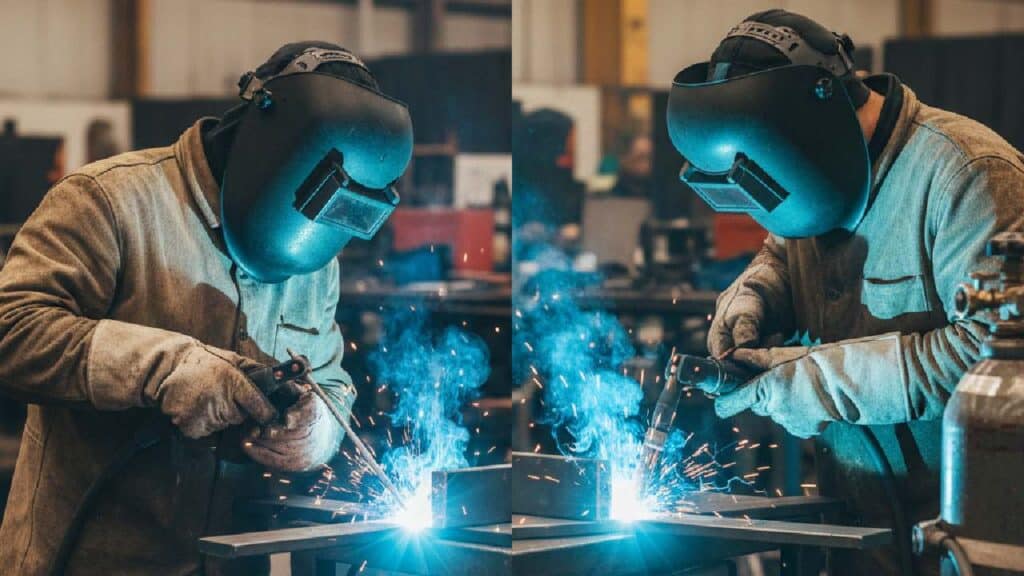
What Is Stick Welding (SMAW)?
Stick welding, also known as Shielded Metal Arc Welding (SMAW), uses a flux-coated consumable electrode. As the electrode burns, the flux creates shielding gas and slag that protect the weld pool from contamination.
This built-in protection is why stick welding still performs reliably in wind, dust, and less-than-perfect conditions.
Stick welding is best known for:
- Strong penetration of thick steel
- Tolerance for rusty, painted, or dirty surfaces
- Simple, portable equipment with no gas cylinder
- Reliable outdoor performance
What Is MIG Welding (GMAW)?
MIG welding, or Gas Metal Arc Welding (GMAW), feeds a continuous solid wire through a welding gun while an external shielding gas (commonly argon/CO₂ mixes) protects the weld.
Because wire feeding is automatic and the arc stays stable, MIG welding is faster to learn and easier to control for most users.
MIG welding is best known for:
- Clean, smooth welds with minimal cleanup
- High welding speed and productivity
- Excellent results on thin to medium materials
- Compatibility with semi-automatic and robotic welding
Stick vs MIG Welding: The Quick Comparison
- Electrode / Wire: Stick uses flux-coated rods; MIG uses continuous wire
- Shielding: Stick generates its own shielding; MIG relies on external gas
- Best Materials: Stick handles, thick and dirty metal; MIG prefers clean material
- Cleanup: Stick leaves slag; MIG produces slag-free welds
- Speed: MIG is faster; stick is slower but more forgiving
- Outdoor Use: Stick works well; MIG struggles in the wind
Which Welding Method Works Better for Different Materials?
Stick welding performs better on carbon steel, structural steel, and cast iron—especially when surfaces aren’t perfectly clean.
MIG welding works best on mild steel, stainless steel, aluminum, and thin sheet metal with proper surface preparation.
If your material is thick or rough, stick welding is usually the safer choice. If it’s thin and clean, MIG will be faster and cleaner.
Which Setup Is Easier to Carry and Set Up?
Stick welding setups are simpler and more portable.
You typically need a power source, electrode holder, ground clamp, cables, and electrodes—no gas bottle required.
MIG welding setups are more complex.
They include a welding machine, wire feeder, gun, shielding gas cylinder, regulator, and hoses, which makes transport and setup more involved.
Which Process Produces Better Weld Quality?
Stick welding produces strong, deeply penetrated welds, especially on thick material. However, slag must be removed, and the finished bead often looks rougher.
MIG welding produces cleaner, smoother welds with little to no post-weld cleanup. It’s preferred when appearance and precision matter.
Which One Is Easier to Learn?
MIG welding is easier for beginners.
Automatic wire feeding and a stable arc reduce coordination challenges and help new welders achieve acceptable results quickly.
Stick welding requires more control.
Maintaining arc length and electrode angle takes practice, and small mistakes are less forgiving.
Safety Considerations: Stick vs MIG Welding
Both processes require proper protective gear.
- Stick welding generates more sparks, slag, and fumes, increasing exposure risks.
- MIG welding produces fewer sparks but introduces hazards related to compressed gas cylinders.
In both cases, a welding helmet, gloves, protective clothing, and adequate ventilation are essential.
Which Welding Method Handles Outdoor Conditions Better?
Stick welding performs better outdoors.
Its flux-based shielding isn’t affected by wind, making it ideal for field repairs and construction sites.
MIG welding is better suited for indoor use.
Wind can blow away shielding gas, leading to porosity and weak welds.
Portability and Remote Job Sites
Stick welding is highly portable and can easily run on generators, making it ideal for remote locations.
MIG welding is less portable due to gas cylinders and additional components, and it’s best kept in workshops or controlled environments.
Typical Applications for Stick and MIG Welding
Stick Welding Applications
- Construction and structural repairs
- Farm and heavy equipment maintenance
- Shipbuilding and pipeline work
- Outdoor and emergency repairs
MIG Welding Applications
- Automotive fabrication and repair
- Furniture and light metal fabrication
- Manufacturing and robotic welding
- Indoor production work
Cost Comparison: Which Is More Budget-Friendly?
Stick welding has a lower startup and operating cost.
Electrodes are affordable, widely available, and easy to store.
MIG welding requires a higher initial investment.
Costs include wire spools, shielding gas, regulators, and ongoing maintenance—but productivity is higher.
So, Should You Choose Stick or MIG Welding?
Choose stick welding if you:
- Weld thick, rusty, or painted metal
- Work outdoors or in windy conditions
- Need a portable, budget-friendly setup
- Perform repairs in remote locations
Choose MIG welding if you:
- Weld indoors in a controlled environment
- Work with thin or clean materials
- Want fast, clean, visually appealing welds
- Prefer an easy-to-learn process
Pros and Cons of Stick and MIG Welding
Pros of Stick Welding
- No external shielding gas required
- Works on AC or DC power
- Excellent penetration on thick steel
Cons of Stick Welding
- More post-weld cleanup
- Slower for high-volume production
- Steeper learning curve
Pros of MIG Welding
- High welding speed
- Cleaner weld appearance
- Easy automation and consistency
Cons of MIG Welding
- Poor performance in windy conditions
- Higher equipment and operating costs
- More maintenance components
Conclusion: Which One Stands Out on Top?
Stick welding stands out for heavy-duty, outdoor, and repair-focused work. MIG welding excels in clean, fast, and high-quality indoor fabrication.
There’s no universal winner—only the right tool for the job you’re doing.
If you’re building or upgrading your welding setup, focus first on your most common materials and work environment. For reliable options across both processes, check out the stick welders, MIG welders, and accessories available from YesWelder—designed for DIY users and professionals alike.
Frequently Asked Questions
Yes—but only in the right conditions. MIG welding is just as good as stick welding for clean, thin to medium materials in controlled indoor environments. Stick welding performs better on thick, dirty, or rusty steel and in outdoor conditions. Neither process is universally better; performance depends on the job, material, and environment.
MIG welding is easier to learn for most beginners. Automatic wire feeding and a stable arc make it more forgiving when hand control isn’t perfect. Stick welding requires more practice to maintain arc length and electrode angle, which makes it harder for first-time welders.
Yes. MIG welding is considered beginner-friendly because it offers consistent wire feed, smooth arc control, and less post-weld cleanup. Many new welders can produce acceptable welds quickly with MIG, especially on thin or clean metal. Proper setup and basic technique still matter, but the learning curve is shorter.
The main disadvantage of MIG welding is its dependence on shielding gas. Wind can blow the gas away, causing weak or porous welds, which limit outdoor use. MIG setups are also more expensive and require more maintenance due to wire feeders, liners, and gas systems.
Stick welding produces more slag and spatter, which increases post-weld cleanup time. It also has a steeper learning curve, as maintaining proper arc length and electrode angle takes practice. For high-volume or precision work, stick welding is usually slower than MIG welding.
For most beginners, a MIG welder or a MIG/Stick multi-process welder is the best choice. MIG allows faster skill development and cleaner results, while a combo machine offers flexibility as skills improve. The best option depends on material thickness, work environment, and long-term use plans.