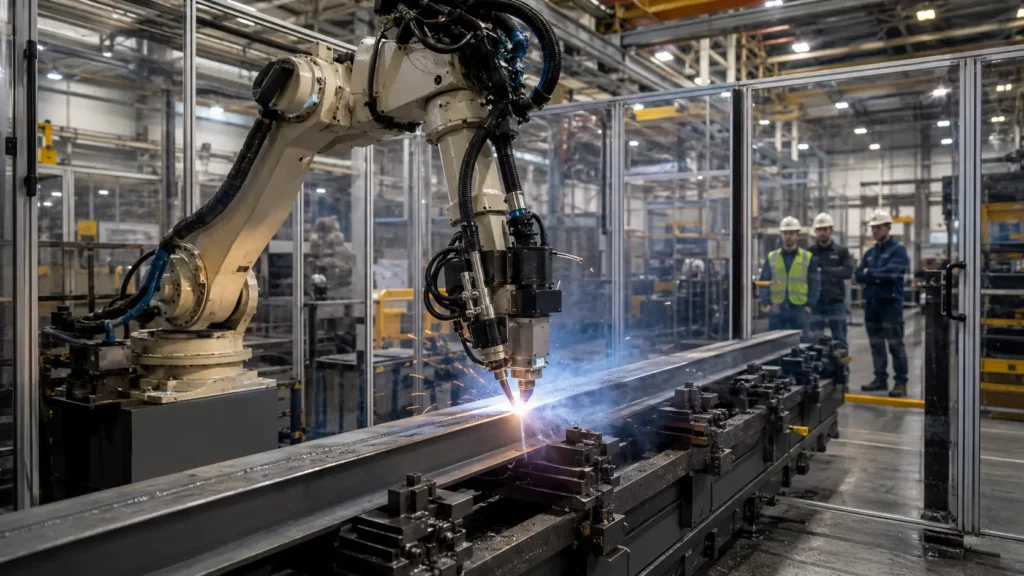
Hybrid laser arc welding combines a laser beam and an arc process in the same weld pool. The laser gives deep penetration, while the arc adds filler metal and helps the weld handle small fit-up gaps.
That is why HLAW can be useful in automated production where speed, weld depth, and distortion control all affect cost.
In this guide, we’ll explain how HLAW works, where it performs best, what can make it expensive, and when the investment makes sense.
What Is Hybrid Laser Arc Welding?
Hybrid laser arc welding is a welding process that uses a laser beam and an arc on the same joint at the same time. The laser creates deep, narrow penetration. The arc adds filler metal, supports the weld pool, and helps the joint handle small gaps.
A Simple Definition of HLAW
Hybrid laser arc welding, often shortened to HLAW, is a process where a laser and an arc melt the same weld pool at the same time.
The laser creates a deep keyhole in the joint. The arc supports the molten pool and feeds filler metal into it. Because both heat sources work together, the process can weld faster and deeper than many arc-only methods while handling more joint variation than pure laser welding.
What Problem Does HLAW Solve?
HLAW solves a production problem that many welding teams know well: laser welding is fast, but it needs tight fit-up. MIG/MAG welding is more forgiving, but it can add more heat, more distortion, and more passes on thicker parts.
Hybrid laser arc welding sits between those two options. It keeps much of the speed and penetration of laser welding, while using arc filler metal to improve tolerance on real production joints.
Why HLAW Is More Than a Simple Equipment Upgrade
HLAW is not just a laser placed beside a MIG torch. It is a full production process that needs the right joint design, fixtures, shielding gas, wire feed, laser settings, arc settings, robot motion, and safety controls.
That is why buyers should treat HLAW as a production investment, not just a machine purchase. A reliable welding equipment supplier can help you think through welding output, automation fit, consumables, operator needs, and long-term support before you move toward a new process.
How Does Hybrid Laser Arc Welding Work?
Hybrid laser arc welding works by using the laser for deep penetration and the arc for filler addition, pool support, and better tolerance.
The Laser Creates the Keyhole
The laser creates a narrow, high-energy beam that melts deep into the metal. At the center of the weld, this energy forms a keyhole, which is a small vapor channel surrounded by molten metal.
A stable keyhole allows deeper penetration with a narrow heat-affected zone. This is one reason HLAW can reduce pass count in some medium-to-thick welds.
The Arc Adds Filler Metal and Process Tolerance
The arc adds heat and filler wire to the weld pool. In laser-MIG/MAG hybrid welding, the wire feeds continuously into the joint, similar to standard MIG/MAG welding. This filler wire helps fill small gaps, shape the weld cap, and adjust weld chemistry. It also makes the process more practical for production joints that are not perfect. This is where knowledge of mig welding wire still matters, because wire type, feed speed, shielding gas, and arc behavior all affect the final weld.
The Synergy Happens in One Weld Pool
The “1+1>2” effect happens because the laser and arc act on the same molten pool. The laser opens the deep path, while the arc adds filler and helps stabilize the pool around it.
Several things happen at once. The laser keyhole changes heat flow in the joint. The arc affects the molten pool and surface shape. The filler wire changes the amount of metal in the joint and can also affect cooling behavior.
Why the Process Pairs Well with Automation
HLAW works best with automation because it needs repeatable positioning. The distance between the laser and arc, the travel speed, the wire position, and the joint tracking must stay stable.
Robots and gantry systems can hold these conditions better than manual work, especially on long seams. Automation also supports laser safety, process monitoring, and consistent weld quality across repeat production.
What Are the Main Advantages of Hybrid Laser Arc Welding?
The main advantages of hybrid laser arc welding are higher speed, deeper penetration, better gap bridgeability, and lower distortion compared with many conventional arc welding setups.
Higher Welding Speed
Hybrid laser arc welding can increase welding speed because the laser adds concentrated energy while the arc feeds filler metal into the same pool.
For example, a factory welding long steel panels may replace several arc weld passes with a faster hybrid process. The time saving does not only come from travel speed. It can also come from fewer passes, less interpass cleaning, fewer part movements, and lower correction work after welding.
Deep Penetration with Fewer Passes
HLAW can produce deep penetration with fewer passes when the joint design, laser power, material, and parameters support it. This can be useful for medium-to-thick sections where standard arc welding may need several passes.
Better Gap Bridgeability
Hybrid laser arc welding handles joint gaps better than pure laser welding because the arc adds filler metal. This makes the process more useful for production work where parts may have small fit-up changes.
A technical data point helps explain the value. TWI’s Hybrid Laser Arc Welding page notes that hybrid welding can extend joint-gap tolerance by at least 2–3 times compared with laser welding alone, depending on the setup and control method.
Lower Distortion and Less Rework
HLAW can reduce distortion because it often uses fewer passes and more concentrated heat than conventional multi-pass arc welding. Less heat spread usually means less shrinkage, less straightening, and fewer dimensional problems.
Which Process Parameters Matter Most in HLAW?
The most important HLAW parameters are laser-to-arc distance, process order, laser power, arc settings, wire feed speed, shielding gas, travel speed, and joint fit-up.
Laser-to-Arc Distance
Laser-to-arc distance controls how closely the two heat sources interact. If the distance is too large, the laser and arc may behave like separate processes. If it is too small, the weld can become unstable.
The right distance depends on the material, travel speed, laser type, torch angle, wire position, and joint design.
Leading and Trailing Configuration
Leading and trailing configuration means which heat source reaches the joint first. In a laser-leading setup, the laser goes first and creates the keyhole before the arc adds filler metal. This can support deep penetration in many joints. In an arc-leading setup, the arc reaches the joint first, preheats the area, and feeds filler before the laser interacts with the pool.
Laser Power, Arc Settings, and Wire Feed
HLAW performance depends on balancing laser power, current, voltage, and wire feed speed. More power does not always mean a better weld. Too much laser power can make the keyhole unstable. Too much arc heat can widen the weld and increase distortion. Too much wire feed can overload the pool.
The same idea applies when selecting a standard mig welder for production work. Output stability, duty cycle, and wire control affect weld quality. HLAW adds a laser to the process, but it still depends on stable arc behavior.
Shielding Gas and Joint Fit-Up
Shielding gas protects the molten pool and affects arc behavior, weld shape, and surface quality. Poor gas coverage can lead to porosity, oxidation, and unstable welding.
Joint fit-up also matters. HLAW can handle more variation than pure laser welding, but it cannot fix poor part preparation.
How Is Weld Quality Evaluated in HLAW?
HLAW weld quality is evaluated by checking penetration, bead profile, fusion, internal defects, mechanical strength, and repeatability in production.
Penetration, Bead Profile, and Fusion
Penetration, bead profile, and fusion show whether the weld is doing its job. Cross-section images and macro-etch samples are useful during procedure development because they show the weld shape below the surface.
A good macro-etch can reveal root penetration, sidewall fusion, undercut, bead width, and heat-affected zone size. These checks help the team see if the laser and arc are balanced correctly.
Common Defects to Watch For
HLAW weld defects usually come from unstable heat input, poor shielding, weak joint tracking, or the wrong filler setup.
- Porosity: Gas pockets can form inside the weld when shielding, surface cleaning, or keyhole stability is poor.
- Lack of Fusion: Weak fusion can happen when heat input, alignment, or travel speed does not match the joint.
- Undercut: Excess arc force, poor torch angle, or high travel speed can cut into the weld toe.
- Hot Cracking: Some alloys can crack when filler choice, dilution, and cooling rate are not controlled.
- Keyhole Instability: An unstable keyhole can cause uneven penetration or internal defects.
Joint Performance in Real Production
A successful HLAW weld must perform across shifts, part batches, fixtures, and operators. One good sample weld does not prove the process is ready.
Production teams should track first-pass acceptance, rework rate, distortion correction, seam tracking alarms, wire feed problems, shielding gas issues, and laser optics condition.
Where Does HLAW Deliver the Most Value?
HLAW delivers the most value in automated production where long seams, repeatable parts, deep penetration, lower distortion, and faster cycle time affect cost.
Shipbuilding and Offshore Structures
Shipbuilding and offshore work often involve long welds, large panels, and distortion control. HLAW can reduce pass count and lower heat input in selected plate and panel applications.
This can reduce straightening time after welding. It can also help automated seam welding when the parts are repeatable enough for robot or gantry systems.
Wind Towers and Heavy Steel Fabrication
Wind towers and heavy steel structures often use long seams and thick sections. HLAW can help when fewer passes and faster weld completion reduce labor and handling time.
The value grows when a plant produces similar parts repeatedly. Long weld length, stable joint design, and good fit-up make the process easier to justify.
Automotive Body Structures and EV Battery Trays
Automotive production needs speed, repeatability, and low distortion. HLAW can fit body structures, chassis parts, and EV battery trays where thermal control and dimensional accuracy matter.
For battery trays, excess distortion can affect assembly. A controlled hybrid process may help maintain shape while still adding filler metal where the joint needs it.
Aerospace and Advanced Alloys
Aerospace and advanced alloy work requires tight control over weld defects, heat input, and mechanical performance. HLAW can be useful when it improves penetration, filler control, or weld consistency. Possible materials include aluminum alloys, stainless steels, nickel alloys, and selected high-strength materials.
How Does HLAW Compare with Pure Laser Welding and MIG/MAG Welding?
HLAW sits between pure laser welding and MIG/MAG welding. It gives more tolerance than pure laser welding and more speed and penetration than many arc-only setups.
A Practical Side-by-Side Comparison
| Factor | Pure Laser | MIG/MAG | HLAW |
| Speed | Very high on tight-fit parts | Moderate to high | High on repeatable seams |
| Penetration | Deep and narrow | Pass-dependent | Deep with filler support |
| Gap Tolerance | Low to moderate | Good | Better than laser-only |
| Distortion | Low when stable | Higher on multi-pass welds | Often lower than arc-only |
| Cost | High | Lower | Highest |
| Automation Fit | Strong but fit-up sensitive | Good | Strong when parts repeat |
When Each Process Makes More Sense
Pure laser welding makes sense when parts fit very well, weld volume is high, and filler metal is not needed.
MIG/MAG welding makes sense for general fabrication, repair, and mixed production where flexibility and lower equipment cost matter.
What Does a Hybrid Laser Arc Welding System Include?
A hybrid laser arc welding system includes a laser source, arc power supply, hybrid head, wire feed, gas delivery, automation, sensing, tooling, and safety integration.
Laser Source and Arc Power Supply
The laser source provides concentrated energy for deep penetration. The arc power supply controls the MIG/MAG, TIG, or other arc process.
Both systems must match the application. A strong laser will not fix poor arc stability, and a high-quality arc supply will not fix poor laser focus or joint tracking.
Hybrid Head, Wire Feed, and Gas Delivery
The hybrid head holds the laser optics and arc torch in the right position. It must maintain alignment, distance, and angle during production.
The wire feed system must feed filler smoothly. Gas delivery must protect the pool and support stable welding. Problems in either area can lead to porosity, spatter, oxidation, or poor bead shape.
Robotics, Sensing, and Safety Integration
Most HLAW systems use robots, gantries, or other automated motion platforms. Seam tracking, vision systems, laser profile sensors, and monitoring tools may also be added.
Laser safety also needs planning. A production cell may require enclosures, interlocks, controlled access, fume extraction, and trained operators.
What Are the Main Challenges of HLAW?
The main challenges of HLAW are high upfront cost, longer process development, safety demands, and poor fit for low-volume or highly variable work.
High Upfront Investment
HLAW costs more than conventional welding because it combines laser equipment, arc equipment, automation, tooling, safety systems, and engineering time.
This cost can be justified when the line has enough repeatable production. For small shops with changing work, the payback may not be strong enough.
Process Development Takes Time
HLAW development takes time because each setting affects the others. Laser power, arc current, wire feed, travel speed, and shielding gas all shape the final weld. A good development plan includes material testing, joint trials, macro-etch checks, destructive testing, NDT planning, fixture validation, and operator training.
Not Every Production Environment Is a Good Fit
HLAW is not ideal for every shop. It needs repeatable parts, controlled fit-up, automation support, and trained staff.
A conventional MIG/MAG, TIG, or stick welding process may be better when parts change daily, seams are short, fixtures are limited, or production volume is low.
Is HLAW Worth the Investment?
HLAW is worth the investment when it reduces total production cost through faster welding, fewer passes, lower distortion, reduced rework, and higher throughput.
What Drives the Total Cost
- Laser Source: Higher power and better beam quality raise cost, especially for thick-section work.
- Automation System: Robots, gantries, or custom motion systems add cost but improve repeatability.
- Hybrid Head: The head must hold optics, torch, wire, and gas delivery in stable alignment.
- Sensing and Monitoring: Seam tracking and process monitoring improve reliability but increase system cost.
- Safety Setup: Enclosures, interlocks, fume extraction, and operator protection are required.
- Tooling and Engineering: Fixtures, trials, qualification, and training add cost before production starts.
Where the Return Usually Comes From
The return usually comes from lower total manufacturing cost, not from speed alone.
HLAW can reduce multi-pass labor, interpass cleaning, part handling, heat straightening, grinding, weld repair, and distortion-related assembly problems. It can also raise line capacity when a faster weld cell removes a bottleneck.
A Simple ROI Screening Checklist
- Annual Seam Length: Count how many meters of similar welds you produce each year.
- Current Multi-Pass Hours: Add welding, cleaning, repositioning, and inspection time.
- Distortion Correction Cost: Track straightening, grinding, rework, and fit-up repair hours.
- Rework Rate: Check how often welds fail inspection or dimensional checks.
- Utilization Rate: Estimate how many hours per shift the HLAW cell can run.
- Automation Readiness: Review fixtures, operators, maintenance, and part repeatability.
- Fit-Up Control: Confirm that gaps and edge preparation can stay inside the qualified range.
Conclusion
Hybrid laser arc welding is worth considering when your production line needs deeper penetration, faster travel speed, better gap tolerance, and lower distortion in repeatable welds. It works best in automated, medium-to-high-volume manufacturing where cycle time, rework, and part handling all affect cost.
It is not the best choice for every shop. If your parts change every day or your welds are short and irregular, a standard MIG/MAG, TIG, or stick welding setup may be more practical. But if you run repeatable seams and want to compare industrial welding equipment for higher throughput, YesWelder Wholesale can help you review suitable welding solutions for your production needs.
Frequently Asked Questions
Yes, hybrid laser arc welding can be used for aluminum, but it needs careful control of filler wire, shielding gas, joint preparation, and heat input.
No, HLAW does not always eliminate groove preparation. It can reduce groove size or pass count in some joints, but joint design still depends on thickness, inspection rules, access, and strength requirements.
Laser-MIG hybrid welding is one type of HLAW. HLAW is the wider category because a laser can be combined with MIG/MAG, TIG, plasma, or other arc processes.
HLAW is usually not the best fit for small fabrication shops unless they have repeatable production, long seams, high-value parts, and enough volume to justify automation.
No, HLAW cannot fully remove the need for tight fixturing. It can handle more variation than pure laser welding, but it still needs controlled joint position, gap size, and part alignment.