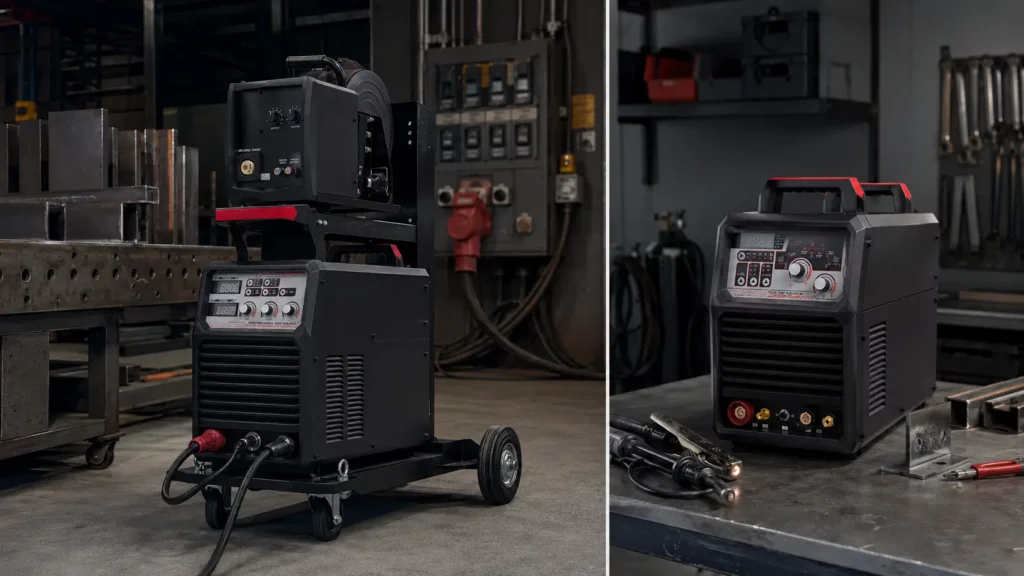
A 3 phase welder is usually the better choice for high-amperage MIG welding, heavy fabrication, structural steel, and long duty-cycle production. A single phase welder is usually the better fit for repair shops, training booths, mobile crews, and facilities without three-phase electrical service.
The choice comes down to workload, available power, installation cost, shop layout, and production needs. This guide compares arc stability, duty cycle, facility power, phase converters, machine types, and service planning so you can choose the right welder setup before purchase.
What Is a 3 Phase Welder?
A 3 phase welder is a welding machine designed to run on three-phase electrical power, the power setup often used in factories, fabrication shops, and production facilities. It is used for higher output, longer welding time, and steadier performance than many single phase machines can support.
Three-phase power uses 3 alternating current lines that overlap in timing. This gives the welding power source a more even supply of electrical energy. In shop use, that can support smoother arc behavior, stronger performance at high output, and cleaner welds with less spatter when the machine, process, and settings are matched correctly.
Common three-phase input voltages vary by region and machine. In the United States, industrial welders often support 230V, 460V, or multi-voltage input. Some machines support both single-phase and three-phase input, but your team should check supplier documentation before assuming compatibility.
Why Three-Phase Power Matters
Three-phase power gives high-output welding machines a steadier electrical supply under load. Arc quality still depends on machine design, process settings, wire or electrode, shielding gas, and operator technique, but the input power gives the machine a stronger base for long, high-amperage work.
That matters when your shop runs heavy wire, thick plate, long welds, or multiple machines in the same work area. Many industrial MIG welders, flux-cored systems, submerged arc systems, and production multi-process machines use three-phase power because they need stable output over longer welding cycles.
What Is a Single Phase Welder?
A single phase welder runs on single-phase electrical power, which is common in homes, small workshops, light commercial spaces, training booths, and many mobile work settings. It is easier to install and often costs less to buy.
Single phase does not mean weak. Many modern inverter welders can produce strong MIG, TIG, Stick, or plasma performance from single-phase input. For repair shops, farm work, training centers, light fabrication, and maintenance tasks, a single phase welder may be the more practical choice.
The limit shows up when the work demands high amperage for long periods. Heavy wire, thick plate, long welds, and multiple shifts can push single phase machines toward their duty-cycle and input-current limits faster.
How Do 3 Phase and Single Phase Welders Compare?
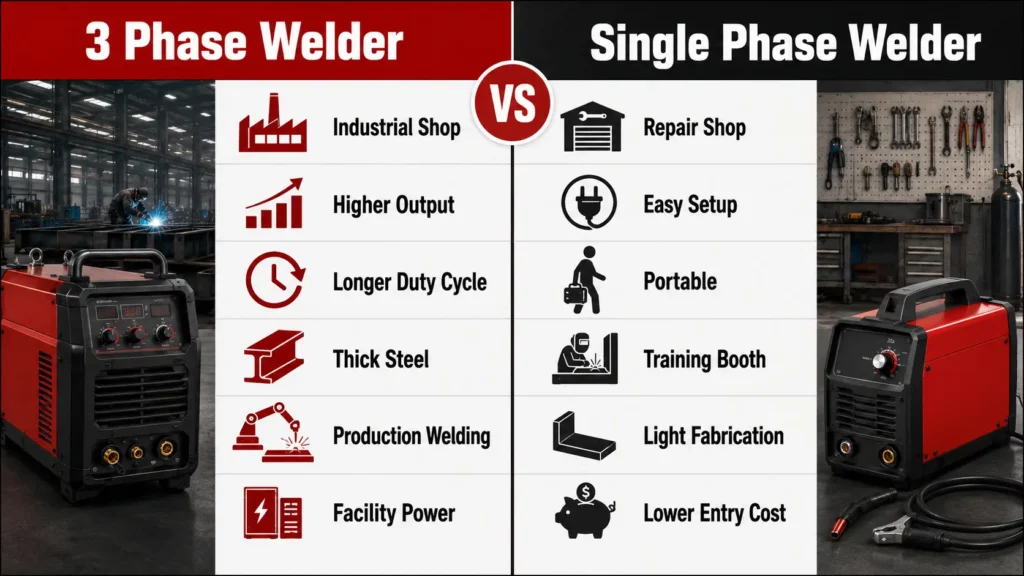
A 3 phase welder usually has the advantage in output capacity, high-amperage duty cycle, arc stability under load, and facility load balance. A single phase welder usually has the advantage in installation access, lower entry cost, and smaller-shop flexibility.
| Factor | 3 Phase Welder | Single Phase Welder |
| Best Fit | Production welding, fabrication shops, plants, structural work | Repair shops, training, mobile work, light fabrication |
| Common Input | Often 230V, 380V, or 460V three-phase, depending on region and model | Often 110V, 120V, 220V, 230V, or 240V single phase |
| Duty Cycle | Stronger at higher output | More limited at high output |
| Arc Behavior | Steadier under heavy load | Strong for lighter work, but more limited at high amperage |
| Electrical Load | Spread across three lines | Drawn through one line pair |
| Installation | Needs three-phase service or approved conversion | Easier in more locations |
| Cost Pattern | Higher machine and installation cost | Lower entry cost and easier setup |
| Best Role | Production welding and industrial workcells | Repair, training, field, and small-shop work |
The right choice depends on how often the machine runs near its upper output range. Short repair cycles can fit single phase well. Long welds, thick plate, heavy wire, and repeated production shifts point toward three-phase equipment.
Why Do Production Shops Choose 3 Phase Welders?
Production shops choose 3 phase welders when welding capacity affects delivery time, labor cost, and weld consistency. The value is not only higher amperage. The real value is whether the machine can keep welding when the job involves thick material, long welds, repeat parts, and multiple stations running in the same facility.
- Longer welding time: Higher duty cycle helps reduce cooling breaks during long welds, repeat parts, and shift work. This matters when welders are running heavy wire or working near the upper output range for much of the day.
- Steadier arc under load: Three-phase input gives high-output machines a stronger power base. That can support smoother MIG, flux-cored, Stick, or TIG performance when the work involves thick plate, structural steel, trailer frames, heavy equipment parts, or production fixtures.
- Better penetration and bead consistency: With the right process, filler metal, shielding gas, and settings, steadier output can support deeper penetration, more consistent bead shape, and less spatter cleanup. That reduces the time spent grinding, reworking, or rejecting parts.
- Better facility load balance: Three-phase machines spread demand across 3 lines. This helps when welders run beside compressors, plasma cutters, fume extraction systems, positioners, grinders, lights, and other shop equipment.
- Room for heavier jobs: A shop adding thicker material, larger assemblies, longer shifts, or more welding stations may outgrow single phase equipment faster. Three-phase machines give the operation more headroom before welding becomes the bottleneck.
For equipment planning, the question is not only how many amps the machine lists. Check whether it can hold the amperage your shop uses every day, support the right welding process, match the available power, and keep up with the production work that creates the most pressure.
When Is Single Phase the Better Choice?
Single phase is the better choice when the work is lighter, the machine needs to move, or the facility does not have three-phase service. It also fits shops that weld in shorter cycles instead of running near maximum output for long periods.
Common fits include repair bays, training booths, farm shops, mobile service, and light fabrication. These jobs often involve fitting, clamping, short welds, grinding, and moving to the next part. In that pattern, installation access and portability may matter more than high-amperage duty cycle.
Single phase should not be treated as a direct substitute for three-phase production equipment. If the work involves thick plate, heavy wire, long welds, or repeated shifts, compare the duty cycle and input-current limits carefully before choosing the easier power setup.
What Types of 3 Phase Welders Are Common?
Common 3 phase welder categories include industrial MIG and flux-cored systems, multi-process power sources, TIG and Stick power sources, automated welding power supplies, and engine-driven welder/generators. The right category depends on process, material, thickness, duty cycle, and whether the machine runs in a fixed workcell or field environment.
Industrial MIG and Flux-Cored Systems
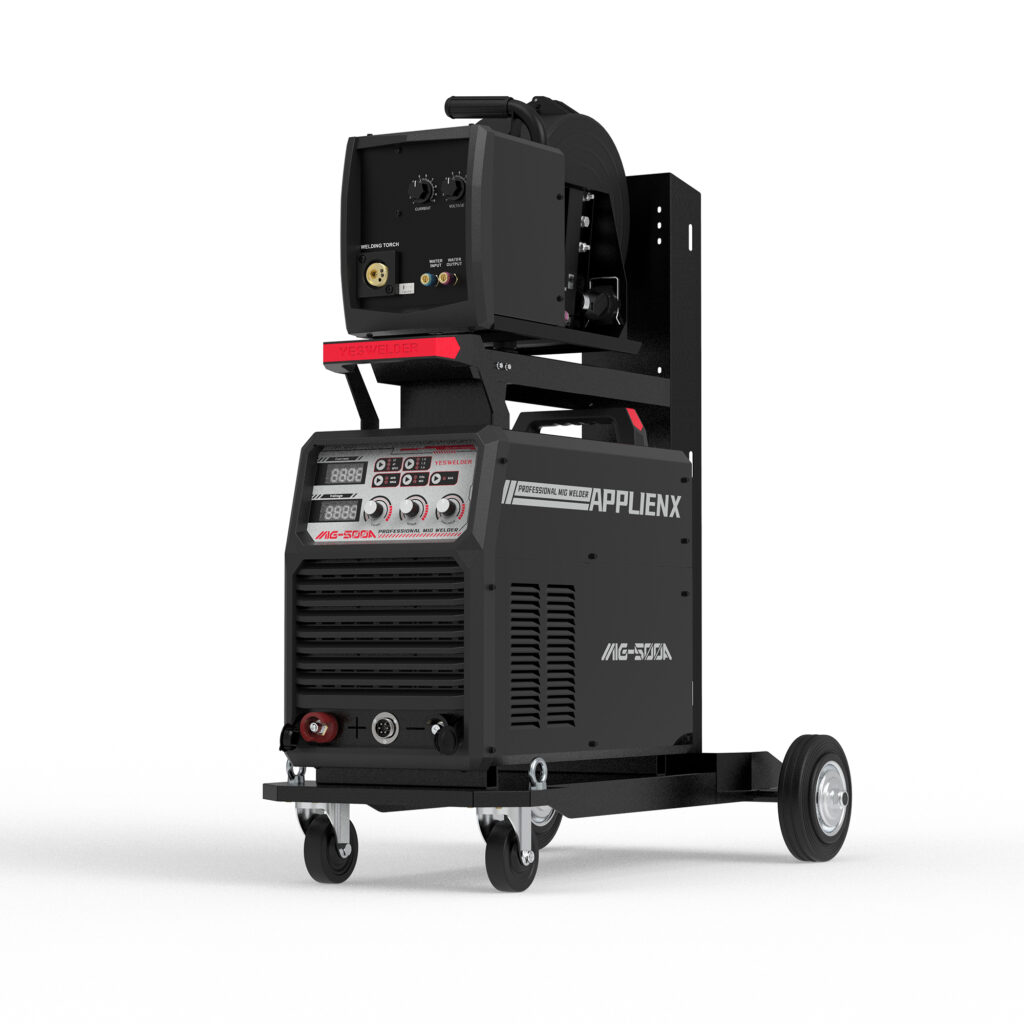
Industrial MIG and flux-cored systems are common in structural fabrication, trailer production, heavy equipment repair, shipbuilding support, and production welding. They are often paired with remote wire feeders, push-pull guns, water-cooled torches, and heavy-duty work leads.
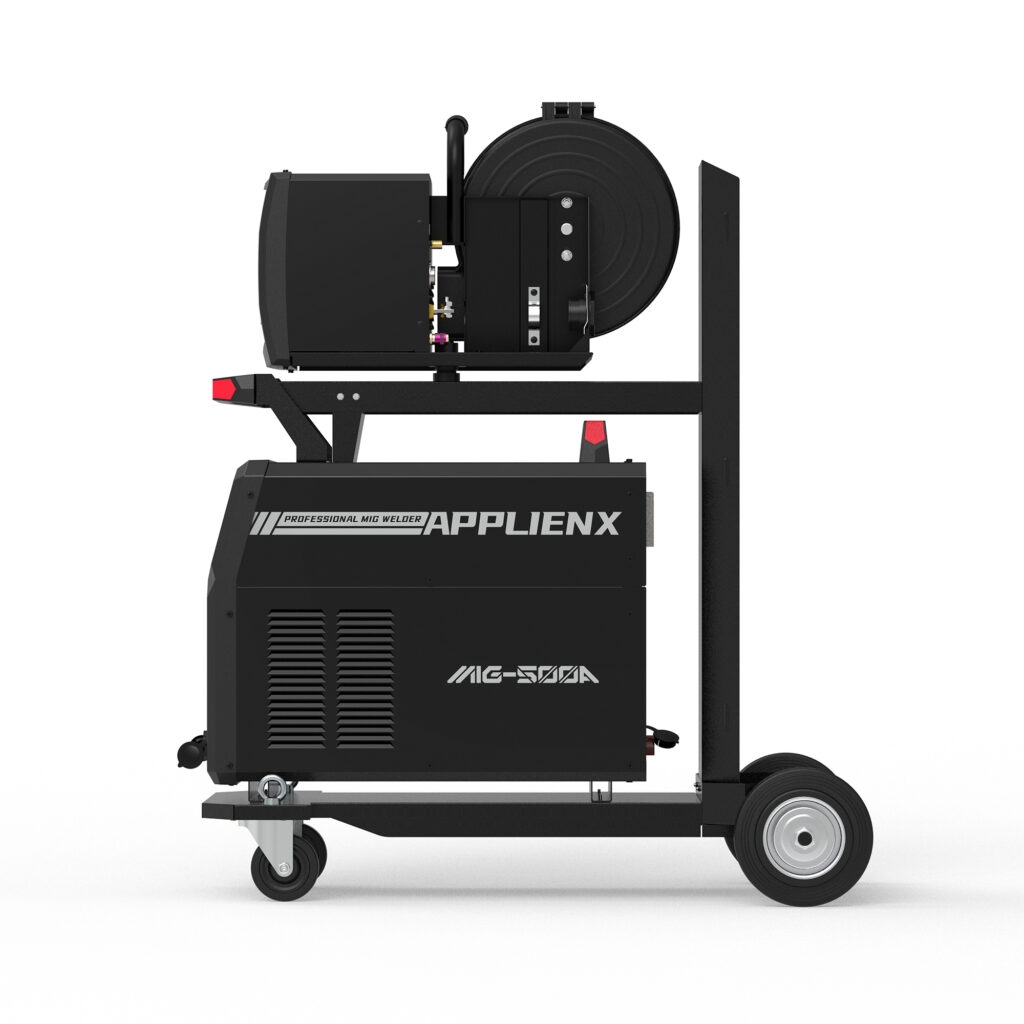
For shops that need high-output MIG or MIG/MMA capability, YesWelder’s APPLINEX MIG-500A and APPLINEX NBM-500 fit this category. Both should be compared by input voltage, duty cycle, process support, cooling setup, wire feeder needs, and the material range your shop handles most often.
Multi-Process Welders
Industrial multi-process machines support more than one welding process from one power source. Depending on the model, they may support MIG, TIG, Stick, flux-cored welding, gouging, or pulse functions.
This category fits shops that need flexibility across changing jobs, but it should not be treated as a shortcut around output and duty-cycle checks. A multi-process machine still has to match the work’s amperage, material thickness, and shift pattern.
TIG and Stick Power Sources
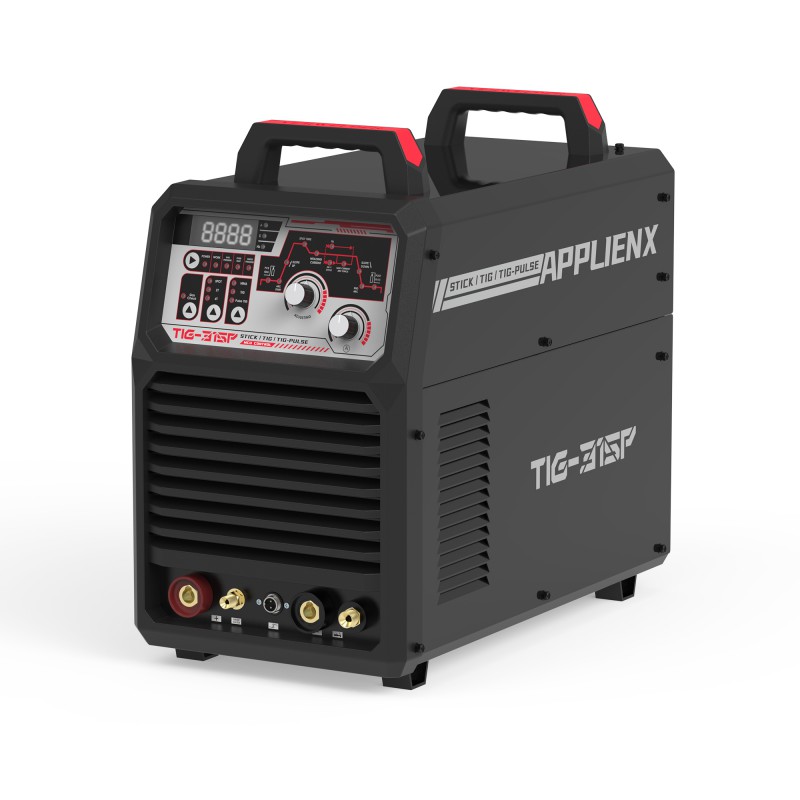
Three-phase TIG and Stick power sources fit pipe shops, industrial maintenance, pressure vessel work, machinery repair, and code-driven fabrication where arc control and output consistency matter.
YesWelder’s TIG-315P fits industrial TIG, MMA, and pulse TIG demand, while ARC-500Q can support heavy Stick work and broader power-input planning. Before choosing either type, compare amperage range, process controls, duty cycle, remote control support, cooling needs, and approved input power.
Engine-Driven Welders and Jobsite Power
Engine-driven machines fit field welding where grid power is limited or unavailable. They may also provide auxiliary power for tools and jobsite equipment.
Keep this category separate from shop-based three-phase welders. A machine that accepts three-phase facility power is not the same as a welder/generator that provides three-phase auxiliary power. Always check the manual and data plate.
What Facility Checks Matter Before Buying a 3 Phase Welder?
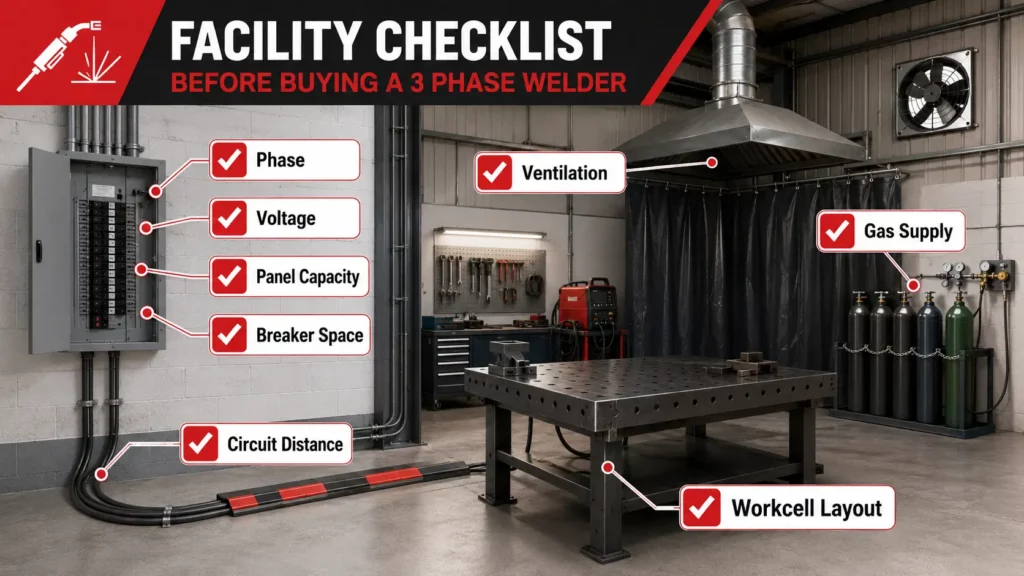
Before choosing a 3 phase welder, confirm your facility power first: available phase, voltage, panel capacity, breaker space, circuit distance, ventilation, gas supply, and workcell layout. The electrical upgrade can cost more than the price gap between a single phase and three-phase machine.
Available Voltage and Phase
Ask the supplier for the product spec sheet, installation requirements, or manual before ordering. Confirm whether the model requires three-phase input and which voltage it supports, such as 230V, 380V, 460V, or another regional standard.
Do not rely on a product name, plug photo, or used-equipment listing. Wrong input can damage the machine, void support, and create safety hazards.
Facility Service Capacity
Your facility needs enough electrical capacity for the welder and the rest of the shop. Compressors, plasma tables, fume extractors, lights, grinders, positioners, and CNC equipment may run at the same time.
Ask a qualified electrician to review the proposed welder’s input current, duty cycle, branch circuit needs, conductor size, disconnect, grounding, and local code requirements before purchase.
Phase Converter Plan
A rotary or digital phase converter can sometimes let a three-phase machine run in a single-phase facility, but it should be planned before the order is placed.
Confirm converter sizing, warranty impact, and performance limits with the machine supplier or manufacturer. If converted power is not approved for that model, the cheaper machine may become the more expensive purchase.
What Should You Compare Before Purchasing?
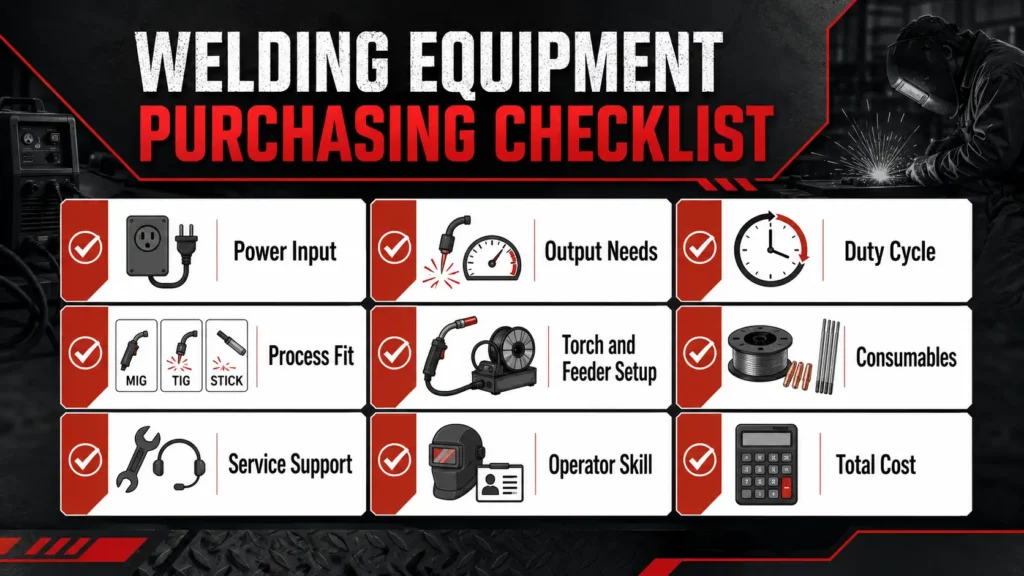
Once the facility can support the machine, compare the welder as part of a full production setup. The lowest purchase price may not be the lowest operating cost if the machine lacks duty cycle, process fit, consumable access, or service support.
| Evaluation Area | What to Check | Buying Risk If Ignored |
| Power Input | Required phase, voltage, input current, breaker, and installation needs | Machine cannot be installed safely |
| Output Needs | Amperage range and welding process support | Machine cannot handle target material thickness |
| Duty Cycle | Rating at the amperage used most often | Overheating and production delays |
| Process Fit | MIG, TIG, Stick, flux-cored, gouging, pulse, or automation needs | Wrong machine for daily work |
| Torch and Feeder Setup | Guns, torches, wire feeder, cooling, leads, and work clamp | Poor fit with the production workflow |
| Consumables | Tips, liners, electrodes, wire, tungsten, torch parts, and PPE | Downtime from missing parts |
| Service Support | Warranty, repair path, spare parts, and technical help | Slow recovery after failure |
| Operator Skill | Setup complexity, controls, training, and documentation | Poor weld quality or unsafe use |
| Total Cost | Machine cost, electrical upgrade, consumables, downtime, and service | Budget looks right at purchase but fails in operation |
Use the table to compare the full setup, not just the amperage number. A good match should weld the target material every week, fit the available power, and have parts and service support available when the shop needs them.
Where Does YesWelder Wholesale Fit?
If your shop is comparing single phase and three-phase welding equipment, start with the pressure points in daily work: thick material, long welds, repeated parts, available power, and service after purchase. The right machine should match the welding process, the facility, and the workload that most often slows production.
YesWelder Wholesale can support different shop needs through several product groups:
- High-output MIG work: APPLINEX MIG-500A fits shops that need a 3P 380V industrial MIG/MMA welder with 500A-class output and external wire feeder support. APPLINEX NBM-500 fits industrial MIG demand where dual pulse, optional water cooling, and aluminum welding support matter.
- TIG, Stick, and mixed industrial repair: TIG-315P supports TIG, MMA, and pulse TIG on 3P 380V input, which fits controlled TIG work at higher output. ARC-500Q supports heavy Stick welding and broader power-input planning for shops comparing industrial Stick capability across available power options.
- Lighter repair, training, or smaller mixed work: Flux-135 PRO, TIG-205P PRO, ARC-125DS PRO, and DP200 can be reviewed separately when installation access, portability, or training setup matters more than high-duty-cycle production output.
These single phase and lighter-duty options should not be treated as direct replacements for three-phase production machines. Before ordering, confirm the official spec sheet, input voltage, duty cycle, process support, included accessories, warranty terms, spare-parts support, service path, and facility installation requirements.
Conclusion
A 3 phase welder is usually the stronger choice when your shop needs high output, longer duty cycles, steadier arc behavior under load, and better power planning for production work. Single phase still has a place in repair bays, training booths, mobile service, and lighter fabrication, but it should not be treated as a direct substitute for three-phase industrial equipment.
Before choosing a machine, compare the work first: material thickness, welding process, amperage used most often, hours per shift, available facility power, installation cost, consumables, spare parts, and service support. If your shop is moving into heavier fabrication, review three-phase industrial options with the official spec sheet and confirm installation requirements before ordering.
FAQs
Only if the machine supports single phase input or the supplier confirms an approved phase converter setup. Check this before placing the order, because converted power can affect performance, warranty support, and installation cost.
Yes, when the shop runs thick material, heavy wire, long welds, or repeated production shifts. For light repair MIG, a single phase machine may be enough.
Confirm the exact input voltage required by the model, such as 230V, 380V, 460V, or another regional standard. Also confirm whether the facility can supply that voltage at the welding area.
Avoid it when the work is light, the machine needs to move often, or the facility would need an expensive electrical upgrade that the workload cannot justify.
Request the official spec sheet, manual or installation requirements, warranty terms, included accessory list, spare-parts information, and service support path.