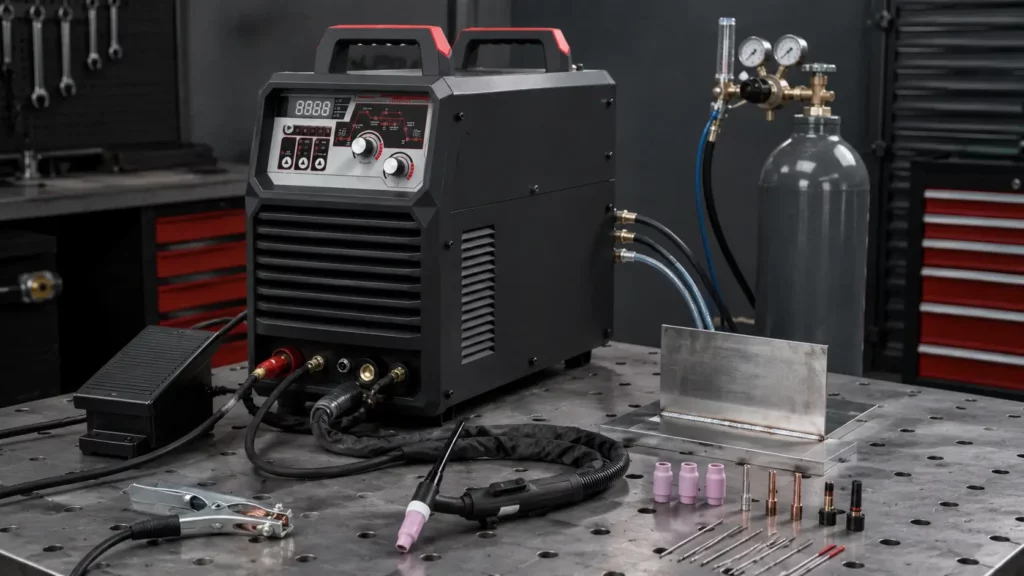
If your shop uses TIG for aluminum frames, stainless assemblies, titanium parts, sanitary piping, repair work, or visible welds, a light-duty TIG unit may not be enough. An industrial TIG welding machine needs to hold a stable arc, manage heat over repeated welds, support the right AC/DC output, and fit the power available in your facility.
The real question is not which TIG machine has the biggest number on the spec sheet. It is whether the machine can handle your material mix, working amperage, duty cycle, torch setup, accessories, spare parts, and support needs without slowing the shop down.
After reading, you should be able to separate a machine that only looks strong on paper from one that fits your shop floor: the right current type, enough duty cycle, usable controls, a realistic torch and cooling setup, and supplier support that does not disappear after the first order.
What Is an Industrial TIG Welding Machine?
An industrial TIG welding machine is a GTAW power source made for repeated shop use, stable arc control, and clean welds on materials such as aluminum, stainless steel, carbon steel, titanium, and alloy steel. It still uses a non-consumable tungsten electrode and shielding gas, but the buying question is not only how the arc works. The real question is whether the machine can handle industrial workload, heat, controls, accessories, and service needs over time.
The industrial label should be backed by measurable capability. Before you compare brands, check the rated output, duty cycle, input power, AC/DC support, pulse controls, torch rating, cooling support, accessory package, documentation, and spare parts plan.
Industrial TIG vs. Light-Duty TIG
| Buying Factor | Light-Duty TIG Unit | Industrial TIG Welding Machine |
| Typical Workload | Short repair jobs, light fabrication, occasional use | Repeated welds, longer seams, production work, training, or industrial repair |
| Output and Duty Cycle | Usually selected around portability and price | Selected around working amperage, duty cycle, and heat management |
| Material Coverage | Often enough for basic steel or stainless work | May need AC/DC output for aluminum and broader material coverage |
| Controls | Basic arc start and amperage control may be enough | Pulse, gas timing, slope control, AC balance, or memory settings may support repeat work |
| Workcell Package | Often sold as a simple machine package | Often needs torch options, cooling, remote control, PPE, consumables, and spare parts |
| Support Needs | Limited parts planning may be acceptable | Documentation, warranty, spare parts, and service response matter more |
A fabrication shop should not choose an industrial TIG machine by maximum amperage alone. The better test is whether the machine fits the shop’s real material mix, working amperage, weld length, operator setup, accessory needs, and after-sales plan.
When Is TIG the Right Process for Industrial Fabrication?
TIG is the right process when weld quality, heat control, material cleanliness, and visible bead appearance matter more than deposition speed. MIG may carry the main production load for thick mild steel, and stick welding still fits many outdoor repair jobs, but TIG earns its place in shops that handle precision parts, thin sections, aluminum, stainless steel, titanium, or sanitary welds.
| Industrial Work | Why TIG Fits | Buying Implication |
| Stainless steel fabrication | Controlled heat, clean bead appearance, and low spatter | Compare low-amp control, gas coverage, pulse settings, and torch access |
| Aluminum frames, tanks, and covers | AC TIG helps break oxide and control the weld puddle | Check AC/DC output, AC balance, amperage reserve, and cooling support |
| Titanium and high-spec alloy parts | Clean shielding and careful heat control protect weld quality | Review gas coverage, post-flow control, arc stability, and operator training needs |
| Process piping and tube work | TIG supports controlled starts, root control, and repeatable weld appearance | Check arc start, remote control, torch size, and documentation support |
| Food, beverage, and sanitary fabrication | Smooth welds and low cleanup help meet cleanability expectations | Compare gas control, heat input control, and repeatability across operators |
| Motorsports and marine fabrication | Lightweight aluminum and stainless assemblies often need clean, controlled welds | Check AC/DC output, torch cooling, fixture access, and accessory package |
| Repair, prototype, and training shops | Mixed materials and short runs need flexible control | Compare dual voltage, process modes, clear controls, PPE, and consumable support |
If your shop only needs fast deposition on thick mild steel, TIG may not be the main process. If the workload includes aluminum, stainless assemblies, titanium parts, sanitary piping, precision repair, or visible welds, an industrial TIG station can become a core shop capability rather than a specialty machine that rarely leaves the corner.
How Should You Match a TIG Machine to Materials and Workload?
Match the TIG machine to the materials and welds your shop sees most often. Current type, amperage, duty cycle, and input power should follow the work, not the other way around.
AC/DC Output for Aluminum, Steel, and Stainless Work
DC TIG works well for carbon steel, stainless steel, chromoly, and many repair jobs. AC/DC TIG gives broader coverage when the shop needs aluminum capability, mixed-material work, or a more versatile TIG station.
If aluminum is a regular part of the workload, check AC balance, AC frequency, cleaning action, and amperage reserve. Aluminum often needs more heat than a similar-looking steel job, and torch cooling can become important faster than expected.
Amperage and Duty Cycle for Daily Shop Use
Amperage should be sized around the output your shop will actually use, not the highest number shown in a catalog or on the machine label.
A 200A class TIG machine can be enough for light fabrication, training, repair work, and thinner stainless parts when the duty cycle is strong at the amperage you use. Heavier aluminum work, long seams, large fixtures, or repeated production shifts usually call for more output reserve and stronger cooling support.
Duty cycle matters because it tells you how long the machine can weld at a rated output before it needs cooling time. Compare duty cycle at your real working amperage, especially if operators weld long seams or the TIG station runs across repeated shifts.
Input Power for Shop and Field Setups
Input power should be confirmed before the machine reaches your floor. Check voltage, phase, breaker capacity, plug type, extension lead limits, generator use, and whether the machine loses output on lower-voltage input.
A portable repair station may need dual-voltage flexibility. A fixed production bay may be better served by a higher-output machine with three-phase input. The right answer depends on where the TIG station will work, how often it moves, and how much output the operator needs there.
Which TIG Machine Design and Controls Matter Most?
Machine design and arc controls matter only when they help your shop work better: easier service, smaller footprint, cleaner arc starts, better heat control, more repeatable settings, or fewer operator-to-operator surprises. A long feature list is not useful by itself. The question is whether those features solve the work your team repeats every week.
Inverter vs. Transformer TIG Machines
Many modern industrial TIG machines use inverter technology because it can reduce footprint, improve power efficiency, and support finer control features in a smaller package. That can help if your shop needs more TIG capacity but has limited floor space, limited power drops, or mobile workstations.
Transformer-based TIG machines can still make sense in some facilities. Your team may already know how to service them, or your maintenance department may already stock parts for that platform. The tradeoff is usually size, weight, power draw, and fewer advanced arc controls.
| Machine Type | Main Advantage | Main Tradeoff |
| Inverter Industrial TIG Machine | Smaller footprint, precise arc controls, pulse features, multi-voltage options, easier movement | More electronic components, so service support and board availability matter |
| Transformer TIG Machine | Familiar design, heavy-duty build, simple operating feel for some welders | Larger size, heavier frame, higher power draw, fewer waveform controls |
If your shop is adding TIG capacity, inverter TIG is often the cleaner purchasing path because it gives you more control per square foot. Still, check service support and parts availability before you buy, especially if the machine will support daily production.
AC Waveform and Pulse Controls
AC waveform and pulse controls are worth checking when your shop needs to manage heat input, aluminum arc behavior, bead shape, or repeatability across similar parts. A simple TIG unit may be enough for occasional maintenance. But if your team handles production parts, training work, or sanitary stainless assemblies, better controls can make good starts, stops, and heat control easier to repeat.
| Control | Why It Matters in Production TIG |
| AC Balance | Adjusts cleaning action and penetration during aluminum TIG welding |
| AC Frequency | Changes arc focus for corners, fillets, and thinner aluminum parts |
| Pulse Control | Helps manage heat input on thin sheet, edges, cosmetic welds, and heat-sensitive assemblies |
| Upslope and Downslope | Reduces abrupt starts, crater defects, and end-of-weld problems |
| Pre-Flow and Post-Flow | Helps protect the tungsten and weld zone before and after the arc |
Match the control package to the work pattern. A repair bench may need fewer menus and faster setup. A fabrication cell, training lab, or sanitary stainless shop may benefit from more precise control and saved settings.
Arc Start, Gas Timing, and Memory Settings
Arc start and gas timing affect weld quality before the operator even reaches steady travel speed. High-frequency start gives you non-contact arc initiation, which can reduce tungsten contamination. Lift start can be useful when your facility needs to limit high-frequency interference.
Memory settings matter when your shop repeats similar parts or trains multiple operators. Saved settings can reduce variation across shifts, but they work best when your team also uses documented procedures and checks them against the job requirements.
| Feature | Best-Fit Use |
| High-Frequency Start | Clean non-contact starts, precision TIG, and reduced tungsten contamination |
| Lift Start | Facilities where high-frequency interference needs to be limited |
| Start Current and Crater Current | Better control at the beginning and end of welds |
| Memory Channels | Repeat parts, training programs, and multi-operator shop setups |
| Remote Control Compatibility | Foot pedal, fingertip control, or torch remote use where access and operator position change |
These controls are not automatically worth paying for in every shop. They become valuable when they reduce rework, protect the weld zone, shorten setup time, or help different operators repeat the same result.
What Should a Complete Industrial TIG Workcell Include?
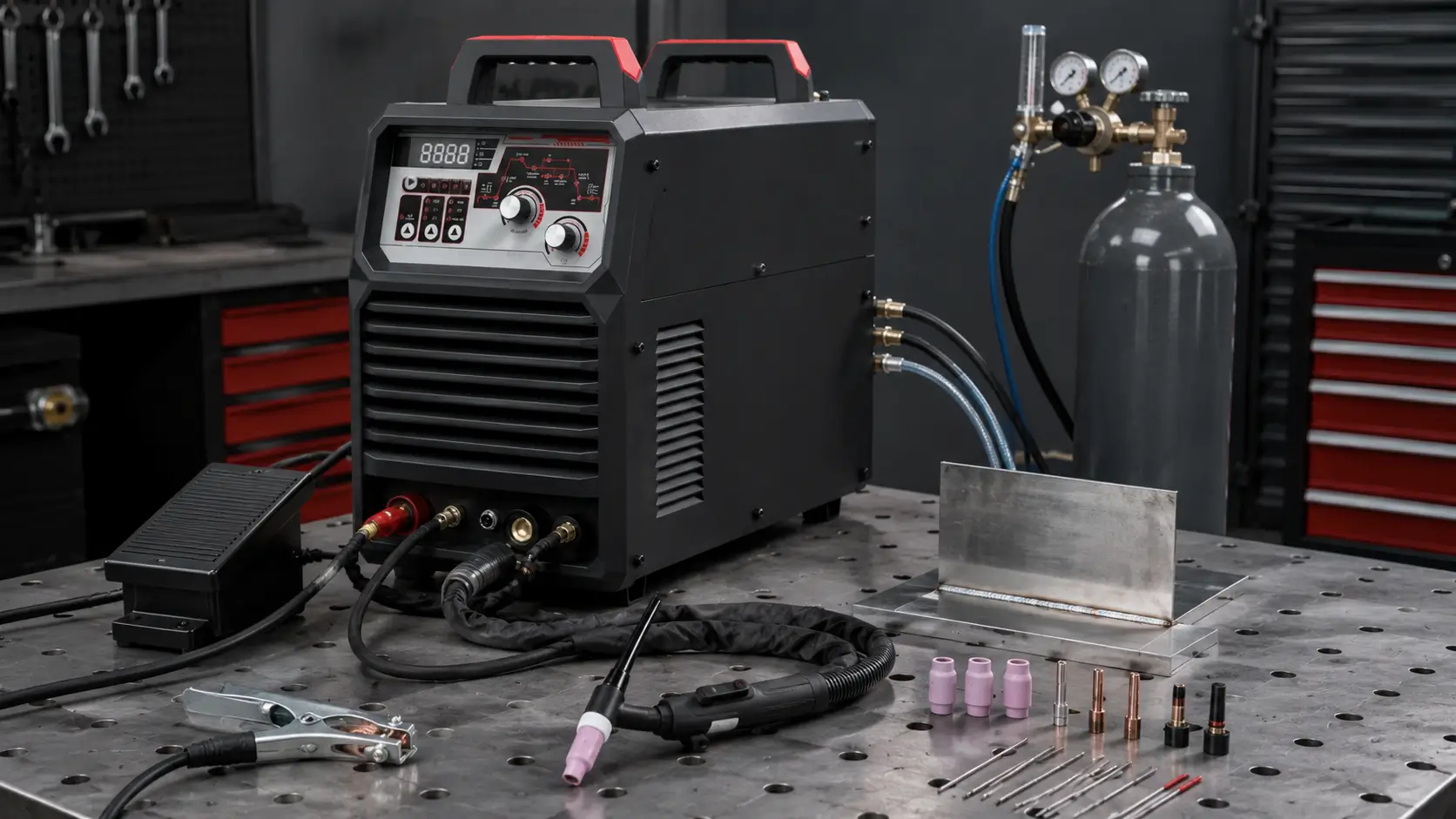
A complete industrial TIG setup is more than the power source. Before you compare quotes, make sure the package can support the way your shop actually welds: torch heat, operator position, shielding gas, PPE, consumables, spare parts, and service access.
Torch Cooling and Workcell Ergonomics
Torch heat becomes a real production issue at higher amperage or during long welds. Air-cooled torches are simpler and less expensive, but they can get hot when the welds run long. Water-cooled torches use a cooler and coolant lines to pull heat away from the torch head, which helps operators keep working during higher-output TIG welding.
Check the welding torch and cooling package with the same attention you give the machine itself. The wrong torch can make a capable TIG power source feel awkward on the shop floor.
| Workcell Item | What to Check |
| Torch Rating | Amperage rating, duty cycle, air-cooled or water-cooled design |
| Torch Access | Torch body size, head angle, and access to tight joints |
| Cable Setup | Cable length, cable cover options, routing, and strain relief |
| Remote Control | Foot pedal, fingertip control, torch remote, or wireless remote compatibility |
| Gas Setup | Gas hose, regulator, flowmeter, cylinder cart, and shielding gas arrangement |
| Cooler Package | Cooler compatibility, coolant lines, maintenance access, and replacement parts |
PPE and Safety Planning
TIG welding can look cleaner than other processes because it produces little spatter, but the hazards are still serious. Industrial TIG work can involve intense arc radiation, hot metal, shielding gas hazards, electrical hazards, and fumes from base metals or coatings.
OSHA’s welding, cutting, and brazing standard covers areas such as ventilation, fire prevention, and eye protection. Your shop should account for those requirements before a new TIG station goes into production.
At the buying stage, include PPE and work area controls in the budget. Depending on the work, that may include welding helmets, gloves, protective clothing, screens, ventilation, fire watch procedures, and training time. Good workstation planning also helps reduce trip hazards: longer TIG leads, torch cable covers, organized carts, and proper work clamps can keep the TIG area cleaner and easier to use.
Accessories, Consumables, and Spare Parts
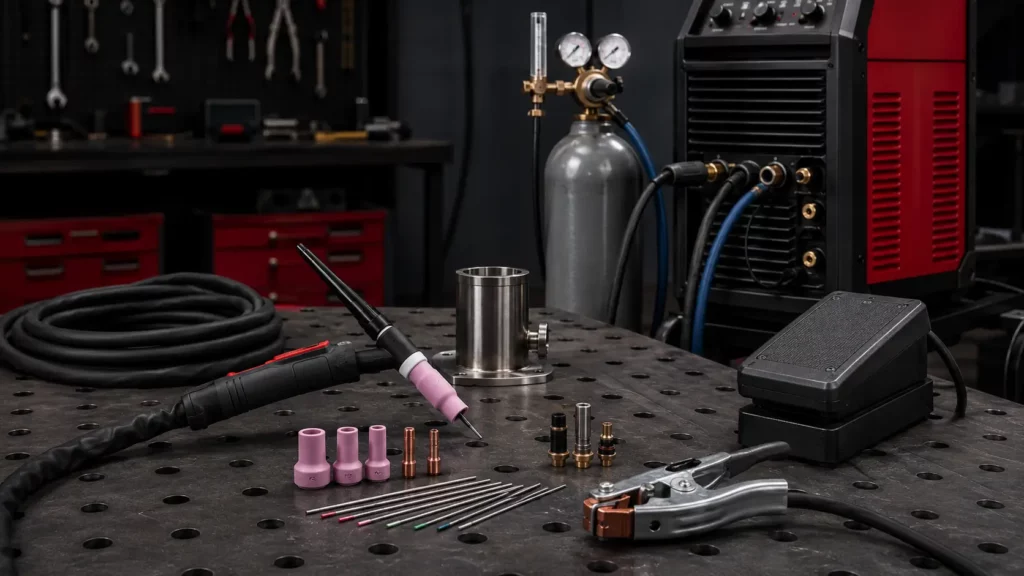
A TIG quote should not stop at the power source. Your shop may also need tungsten electrodes, cups, collets, gas lenses, back caps, torch parts, coolant, ground clamps, regulators, flowmeters, PPE, and replacement parts.
This is where industrial buying differs from a simple machine purchase. If a torch part, gas lens, pedal, or cooler component is hard to replace, a good machine can still sit idle. Ask the supplier which consumables and spare parts should come with the first order, which wear parts should be kept on hand, and how quickly replacements can be supplied when the TIG station is used every day.
How Should You Compare Industrial TIG Machines?
When you compare industrial TIG machines, avoid looking at one headline number in isolation. A machine with higher maximum amperage is not automatically the better choice if the duty cycle is weaker, the torch package is incomplete, the controls are harder to repeat, or spare parts are difficult to source.
A fair comparison starts with the work your shop actually does: material type, material thickness, weld length, operator skill level, daily run time, facility power, and how quickly the machine must be supported if something fails.
Compare Core Specs on the Same Basis
Use the same checklist for every machine on your shortlist. That makes weak points easier to see.
| Comparison Point | What to Check |
| Output Range | Low-amp control, daily working amperage, and upper-end reserve |
| Duty Cycle | Rated duty cycle at the amperage your shop will actually use |
| AC/DC Capability | DC TIG for steel and stainless; AC/DC TIG if aluminum is part of the workload |
| Input Power | Voltage, phase, plug requirements, generator compatibility, and shop power availability |
| Arc Controls | HF start, pulse, AC balance, AC frequency, slope control, gas timing, and memory settings |
| Torch Package | Air-cooled or water-cooled torch, torch rating, cable length, and remote control options |
| Cooling Support | Cooler compatibility, coolant lines, maintenance access, and replacement parts |
| Documentation | Manual, data sheet, warranty terms, certifications, and setup instructions |
| Spare Parts | Torch parts, consumables, boards, pedals, coolers, and expected replacement timeline |
| Supplier Support | Technical response, warranty handling, sample order process, and after-sales service |
Look Beyond Maximum Amperage
Maximum amperage matters, but daily performance matters more. If your shop usually welds thin stainless, sanitary tube, or repair parts, low-amp control, clean arc start, gas timing, and torch access may matter more than a higher top-end number.
For aluminum, longer seams, or repeated high-amp work, check output reserve, duty cycle, AC controls, and cooling support more carefully.
If you can see a demo, pay attention to the practical details: whether the arc starts cleanly, whether the interface is easy to adjust, and whether operators can change settings without slowing down the job.
Use Known Industrial Models as Benchmarks
Well-known industrial TIG machines are useful reference points because they show what industrial shops often compare: stable arc performance, AC/DC capability, pulse control, multi-voltage input, torch compatibility, and long-term service support.
Your shop may not need the most expensive industrial TIG unit. It needs a machine that fits your material mix, workload, power supply, operator habits, accessory package, and support expectations.
What Buying Mistakes Should You Avoid?
Industrial TIG machines are easy to compare badly if you only look at the machine body and quoted price. Before ordering, watch for mistakes that can affect daily use, setup time, and long-term support.
- Choosing by maximum amperage alone: The machine may look strong on paper but still fall short at your real working amperage or duty cycle.
- Ignoring AC/DC requirements: A DC-only TIG machine may not fit aluminum work, even if it covers steel and stainless well.
- Underestimating duty cycle: Long welds, repeated shifts, and aluminum work can expose weak heat management quickly.
- Forgetting facility power: Voltage, phase, plug type, breaker capacity, and generator use should be checked before the machine arrives.
- Treating the torch as an afterthought: A poor torch match can make an otherwise capable machine harder to use all day.
- Leaving cooling out of the quote: Higher-amperage TIG work may need water cooling, coolant lines, and replacement parts.
- Not checking consumables and spare parts: Missing cups, collets, gas lenses, torch parts, pedals, or cooler parts can stop work later.
- Comparing a complete package with a bare machine: A lower quote may not include the items your shop actually needs to start welding.
- Skipping documentation and support checks: Manuals, warranty terms, setup guidance, and service response matter more once the machine is in production.
The safer buying decision is usually not the cheapest quote or the highest headline output. It is the TIG setup your shop can power, operate, maintain, and support without surprises.
Which YesWelder TIG Options Fit Different Shop Needs?
Include YesWelder Wholesale in your TIG machine comparison when your shortlist covers industrial welding machines, AC/DC TIG capability, pulse control, plasma cutting, welding helmets, accessories, consumables, or spare parts.
For shops and distributors, the useful question is not only “Which TIG machine is available?” It is whether the supplier can support the full buying picture: machine specifications, product documentation, wholesale terms, MOQ, lead time, packaging support, warranty details, spare parts, and after-sales response.
| YesWelder Option | Best-Fit Use |
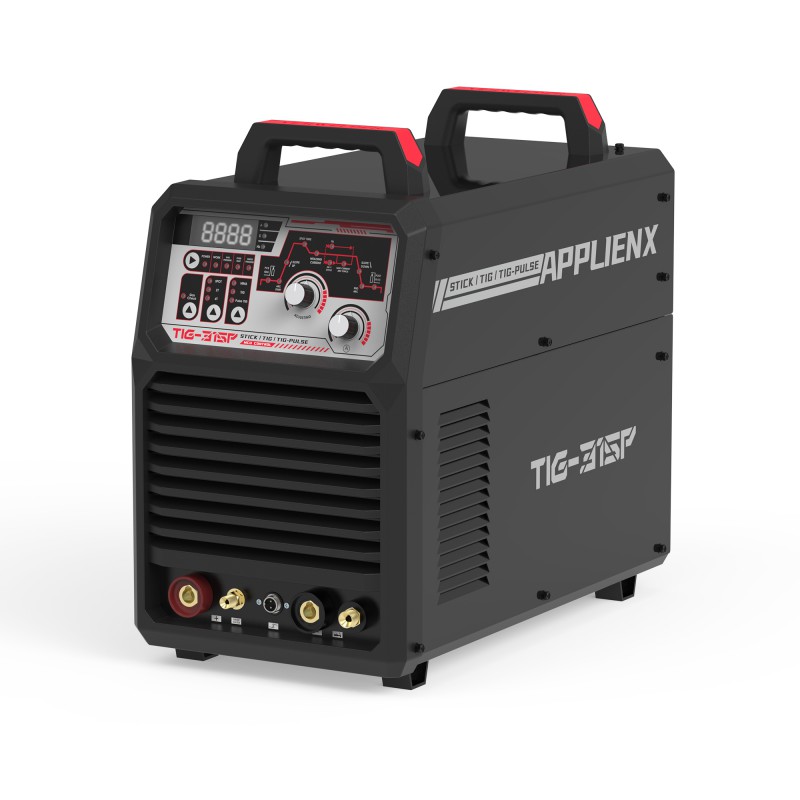
| TIG-315P | Higher-output TIG work, industrial repair, fabrication shops, and setups that need more amperage reserve |
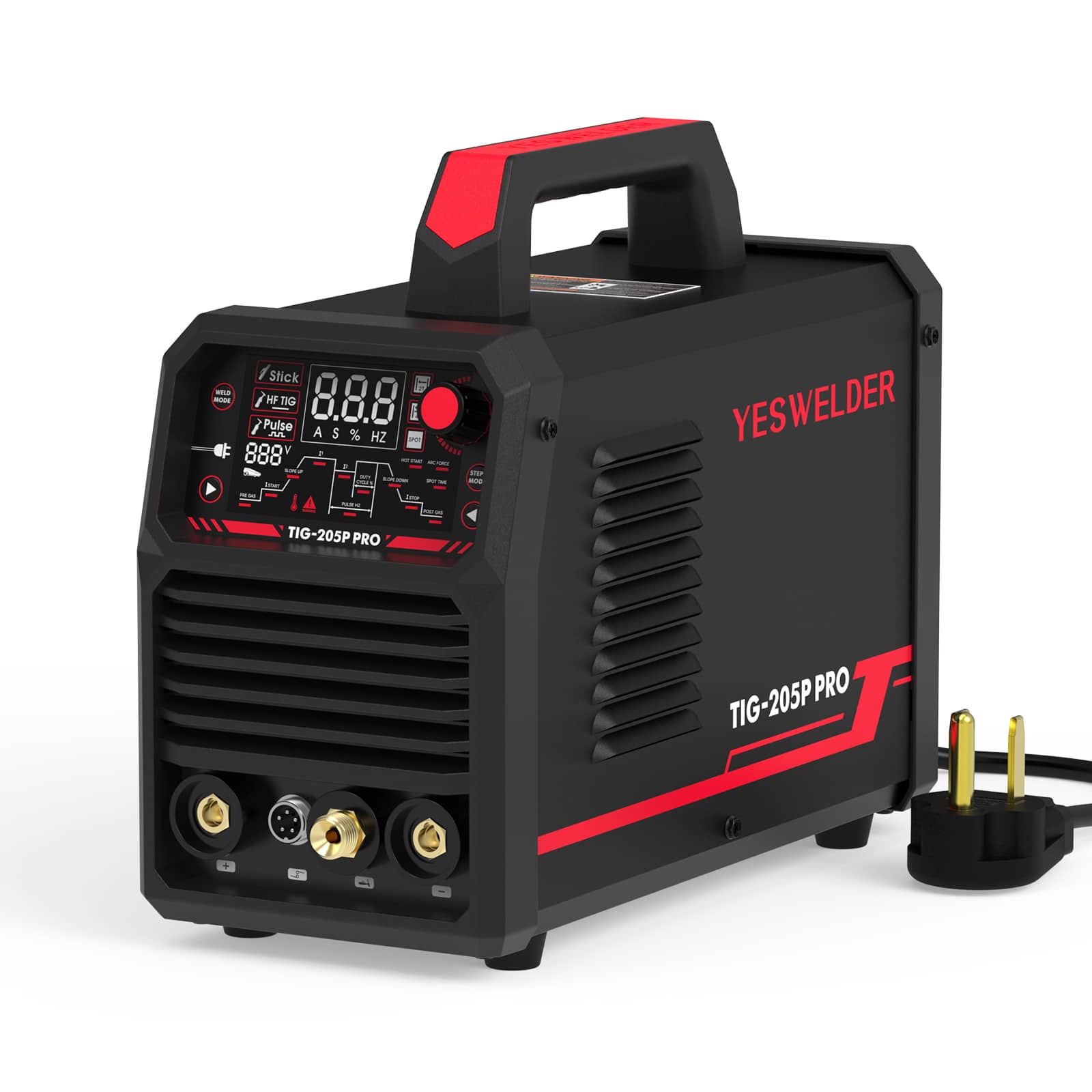
| TIG-205P PRO | Pulsed DC TIG work for steel, stainless, repair jobs, and lighter fabrication |
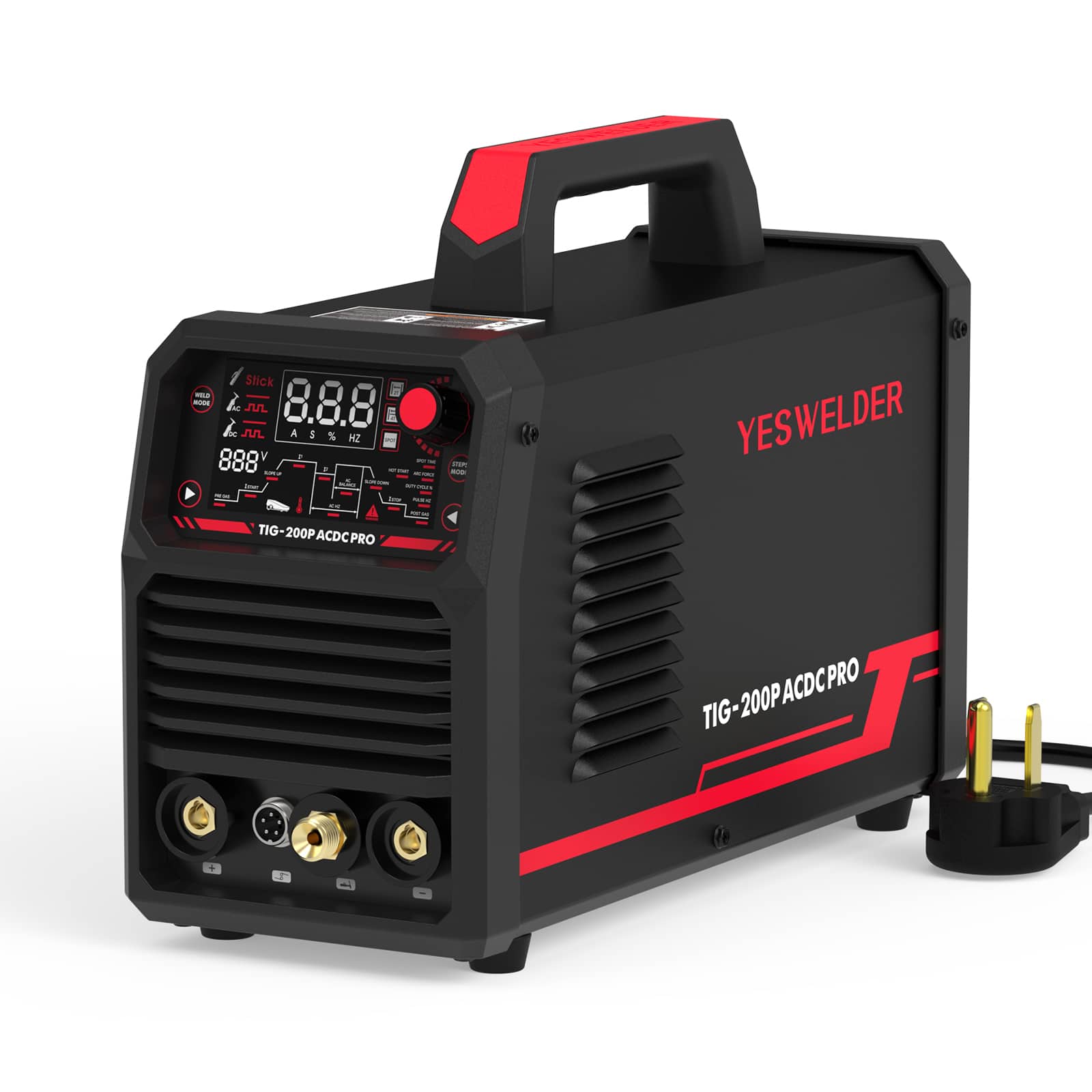
| TIG-200P PRO ACDC | AC/DC TIG coverage for aluminum, steel, stainless, and mixed-material shop work |
| Plasma Cutters | Shops or distributors that want cutting capacity alongside welding equipment |
| Welding Helmets and Accessories | Teams building a more complete welding package instead of sourcing only the machine body |
| Consumables and Spare Parts | Repeat supply, after-sales support, and daily shop maintenance needs |
If you are comparing YesWelder with other TIG machine suppliers, use the same checklist from the earlier sections. Confirm the working amperage, duty cycle, AC/DC requirements, input power, torch package, consumables, spare parts, warranty terms, and support process before placing an order.
What Should You Check Before Accepting a TIG Machine Quote?
A TIG quote should be checked against the full working setup, not only the machine price. Before you accept it, confirm what is included, what needs to be added, and what support will be available after delivery.
Use the quote review to check:
- Machine configuration: Model, output range, AC/DC capability, pulse functions, duty cycle, input power, and process modes.
- Torch and cooling package: Torch type, torch rating, cable length, remote control options, cooler compatibility, coolant lines, and replacement parts.
- Accessories and consumables: Tungsten electrodes, cups, collets, gas lenses, back caps, regulators, flowmeters, ground clamps, PPE, and first-order spare parts.
- Documentation: Product manual, data sheet, warranty terms, certifications, setup instructions, and maintenance guidance.
- Commercial terms: MOQ, lead time, payment terms, packaging options, private label or regional program details if applicable.
- After-sales support: Technical contact, warranty process, spare parts availability, response time, and support for future repeat orders.
The goal is to avoid a quote that looks low only because important items were left out. A stronger quote should make it clear what your shop can weld on day one, what parts are included, and how the supplier will support the machine after it arrives.
Conclusion
Choosing an industrial TIG welding machine is less about chasing the largest output number and more about matching the machine to real shop work. Materials, weld length, duty cycle, AC/DC output, input power, torch cooling, controls, accessories, spare parts, and supplier support all affect whether the TIG station can perform consistently after it arrives.
For fabrication shops, repair teams, training programs, and distributors serving industrial users, the best choice is usually the machine package that fits the full workflow: the parts being welded, the operators using the machine, the power available in the facility, and the support needed after delivery.
If you are comparing TIG machines for your shop or wholesale catalog, YesWelder Wholesale can help you review current TIG options, plasma cutters, welding helmets, accessories, consumables, spare parts, MOQ, lead time, warranty details, and wholesale program support. Contact the YesWelder Wholesale team to request current specifications and quote details.
Frequently Asked Questions
An industrial TIG welder should support repeated shop use, stable arc control, proper duty cycle, suitable input power, and the torch, cooling, accessory, documentation, and spare parts support needed for production or industrial repair work.
Not always. DC TIG can work well for carbon steel, stainless steel, and many repair jobs. AC/DC TIG becomes important when your shop needs to weld aluminum or wants broader material coverage from one TIG station.
It depends on material thickness, weld length, duty cycle, and how often the machine runs. A 200A class TIG machine may fit light fabrication, training, repair work, and thinner stainless parts. Heavier aluminum work, longer seams, and repeated production shifts usually need more output reserve.
Duty cycle shows how long a machine can weld at a rated output before it needs cooling time. For industrial TIG work, check duty cycle at the amperage your shop will actually use, not only at a low-output rating.
Air-cooled torches are simpler and easier to manage for lighter or shorter welds. Water-cooled torches are better for higher-amperage TIG work, long welds, and repeated daily use because they help control torch heat.
A quote should show the machine model, output range, AC/DC capability, duty cycle, input power, torch package, cooling setup if needed, accessories, consumables, spare parts, documentation, warranty terms, lead time, MOQ, and after-sales support.
YesWelder Wholesale offers TIG welding machines and related welding categories for fabrication shops, distributors, and wholesale customers. Current specifications, availability, MOQ, lead time, warranty details, spare parts support, and wholesale terms should be confirmed with the YesWelder Wholesale team before ordering.