An industrial welding machine is a high-output welding power source built for production welding, heavy fabrication, structural work, and repair environments where uptime matters.
Compared with light shop welders, an industrial welding machine usually has higher amperage, stronger duty cycle ratings, heavier cable support, better cooling, and input power options suited to factory or field work.
In practice, the question is not only “How many amps does it make?” The better question is whether the machine can support the weld process, material thickness, shift pattern, power supply, operators, and service plan behind your work.
This guide explains the key industrial welding machine specs to compare, the main machine types available, and how to match a welder to real production, repair, or distributor needs.
What Makes a Welding Machine Industrial?
The “industrial” label should be tied to measurable specs, not only machine size, price, or marketing language.
Look for rated output, duty cycle at that output, input voltage, process support, wire-feeder capacity, cooling design, cable length limits, torch compatibility, and service documentation.
Maximum amperage only tells part of the story. Buyers should also check the rated output and duty cycle at the amperage they expect to use most often.
For most operations, the application sets the spec.
A trailer shop running long MIG beads on mild steel needs wire-feed stability and duty cycle. A maintenance crew repairing heavy equipment may need stick performance, long cable support, and tolerance for rough environments.
A stainless fabrication cell may need pulsed MIG or TIG control for heat-sensitive parts.
How Is an Industrial Welding Machine Different From a Light-Duty Welder?
An industrial welding machine is built for output capacity, heat control, and long work cycles. A light-duty welder is usually built for portability, lower input power, and occasional repair work.
If your shop runs longer welds, repeated parts, or multi-shift jobs, the difference shows up in the specs.
| Selection Factor | Light-Duty Welder | Industrial Welding Machine |
| Output range | Commonly under 200-250 amps | Often 250 amps and above, with many production machines in the 250-600A range |
| Duty cycle | Lower at rated output | Higher duty cycle at useful amperage |
| Input power | Often 120V or 240V single-phase | Often 208V, 230V, 380V, 460V, or 575V, sometimes 3-phase |
| Work pattern | Intermittent repair or small jobs | Longer welds, repeated parts, multi-shift use |
| System fit | Basic gun, clamp, and leads | Feeders, torches, coolers, carts, remote controls, and documented service parts |
Duty cycle deserves special attention. A 60% duty cycle usually means the machine can weld for 6 minutes in a 10-minute period at the listed amperage, then cool for 4 minutes.
A 100% duty cycle means continuous operation at the stated rating under the manufacturer’s test conditions. Always read the rating line carefully because duty cycle changes with amperage.
What Specs Should You Compare First?
Start with the specs that affect the work your machine has to do every day: rated output, duty cycle, input power, process support, cooling, and the parts that keep the setup running.
A low price does not help much if the welder cannot handle your weld length, shift pattern, or main process.
Rated Output and Amperage Range
Rated output shows what the machine can deliver under defined test conditions. Amperage range shows how low and how high the machine can go.
Maximum amperage is only the ceiling. Rated output and duty cycle tell you how much of that power you can use during real work.
For heavy fabrication, many industrial machines sit in the 250-600A range. For thin stainless, aluminum, or TIG work, stable low-amp control may matter as much as top-end power.
Do not choose by maximum amperage alone. Start with the amperage your team uses most often, then compare duty cycle at that point.
Duty Cycle at the Right Amperage
Duty cycle only makes sense when you read it with amperage. A machine rated 500A at 40% duty cycle can behave very differently from a machine rated 350A at 100% duty cycle in production.
Use this table as a quick check:
| Welding Pattern | Duty Cycle Priority | Selection Note |
| Short repair welds | Medium | Cooling breaks may already exist in the workflow |
| Long production seams | High | Compare duty cycle at the actual production amperage |
| Robotic or automated cells | Very high | Thermal limits affect uptime and part consistency |
| Field maintenance | Medium to high | Ambient heat, cable length, and generator load can reduce practical capacity |
Input Voltage and Phase
Industrial welding machines often need more than household power. Many shop machines use 3-phase input such as 208V, 230V, 380V, 460V, or 575V, depending on the region and facility wiring.
Before you choose a model, confirm the building power, breaker capacity, plug type, extension rules, and whether the welder accepts multiple input voltages.
A machine can look right on paper and still be wrong for a branch location with different site power.
Process Support and Controls
Process support needs to be specific. “MIG capable” is not enough for production MIG.
Check the wire diameter, gas type, feeder, torch, pulse mode, spool size, and polarity your work requires.
For TIG, look at AC/DC, pulse, high-frequency start, post-flow control, water-cooling support, and low-amp stability.
For stick, check hot start, arc force, electrode size range, and open circuit voltage. For flux-cored welding, confirm polarity, drive rolls, gun rating, and ventilation needs.
Cooling, Accessories, and Consumables
Industrial welding machines handle heat through fan design, heat sinks, power electronics, water-cooled torches, and thermal protection systems.
Cooling should be treated as part of the production setup because it helps protect uptime.
The power source is only one part of the welding setup. Long leads, undersized ground clamps, worn liners, poor contact tips, or mismatched drive rolls can make a good machine perform badly.
If you sell, stock, or service welding machines, the parts around the power source deserve the same attention:
- Torch and gun availability
- Contact tips, nozzles, liners, and drive rolls
- Electrode holder and work clamp quality
- Wire-feeder roll capacity
- Water cooler compatibility
- Common spare parts and repair turnaround
A strong industrial setup needs repeatable consumable supply, not only a strong power source. This is where welding accessories affect day-to-day machine performance.
What Types of Industrial Welding Machines Are Available?
Industrial welding machines are usually grouped by welding process and power delivery. Once you know the specs to compare, match the machine type to the joint, material, production speed, and work environment.
Industrial MIG Welders
Industrial MIG welders are common in fabrication shops, trailer manufacturing, agricultural equipment, structural components, and robotic cells. MIG supports high travel speed and high deposition, which makes it useful for repeated parts and long seams.
For an industrial MIG setup, check:
- Wire diameter range
- External wire-feeder support
- Spool capacity, such as 15 kg rolls
- Synergic control or pulsed MIG support
- Torch cooling requirements
- Drive-roll quality and service access
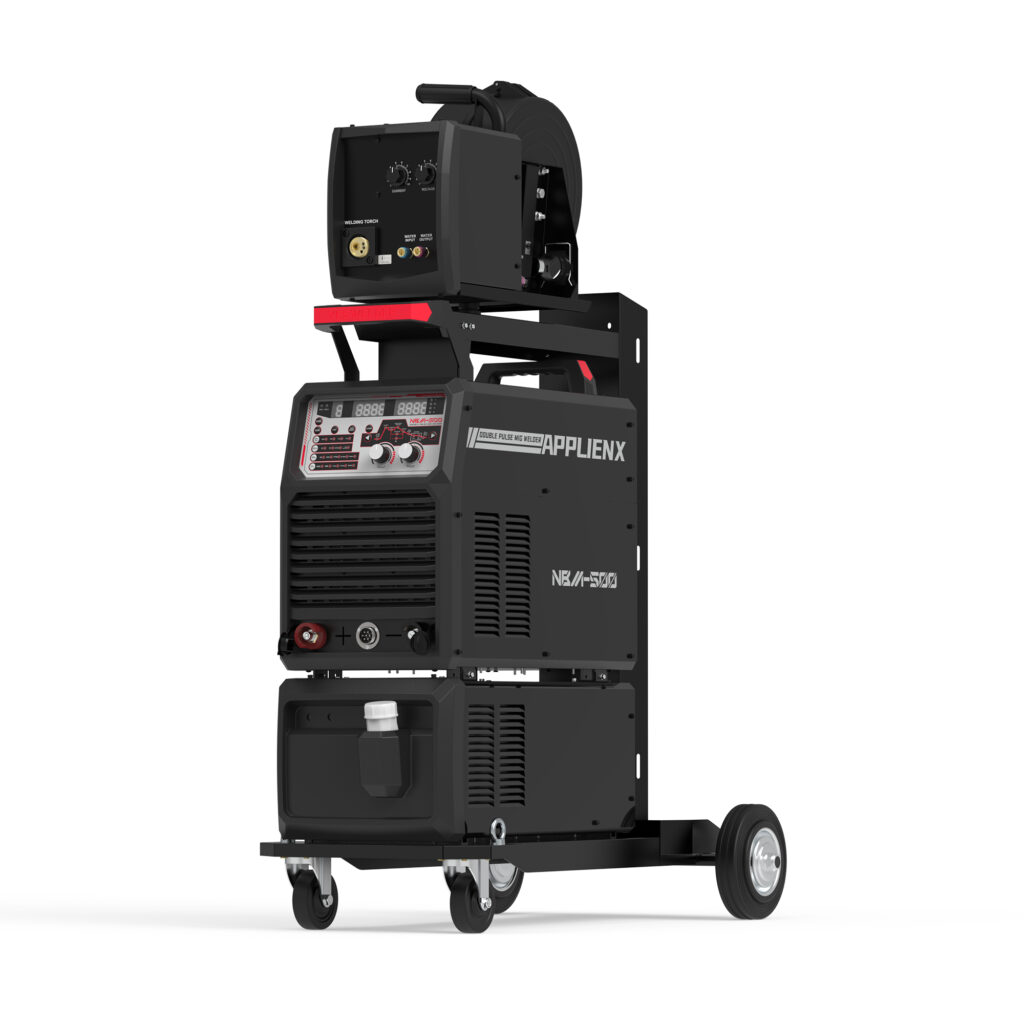
As a spec example, the YesWelder APPLINEX NBM-500 is listed as a 500A dual-pulse industrial MIG welder with 3-phase 380V input, a 40-500A adjustment range, 60% duty cycle, external wire feeder, 15 kg spool support, and optional water cooling.
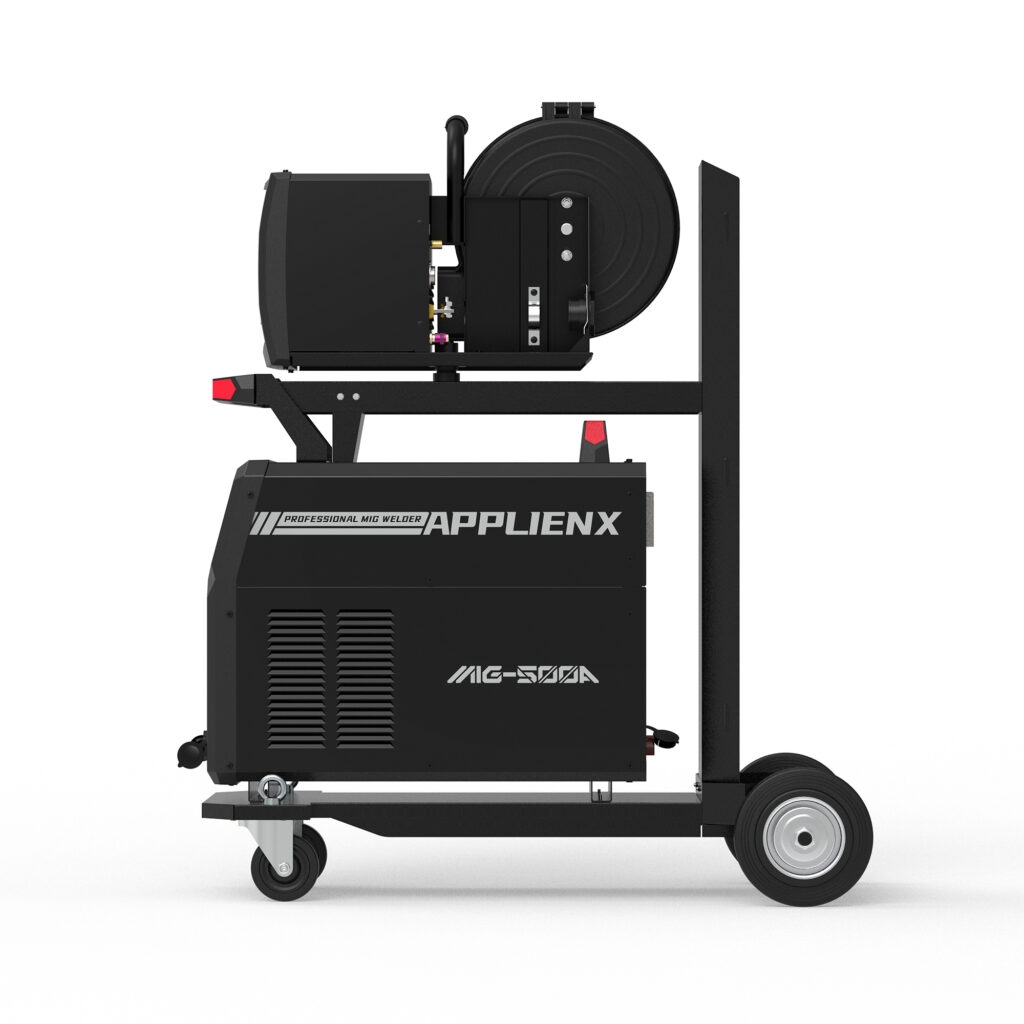
For shops that need MIG/MMA coverage in a high-output setup, the APPLINEX MIG-500A is another industrial option with 3-phase 380V input, 40-500A current adjustment, 60% duty cycle, external wire-feeder support, and optional water cooling.
For mixed-use industrial demand, the APPLINEX MIG-350K gives distributors a smaller industrial MIG/MMA option with built-in wire feeder, spool gun compatibility, support for up to 15 kg MIG wire rolls, and 60% duty cycle at 350A.
Industrial TIG Welders
TIG is usually selected when control matters more than deposition speed.
Industrial TIG welders are used for stainless steel, aluminum, copper alloys, aerospace-adjacent parts, food-grade fabrication, pipe work, and repair jobs where bead control matters.
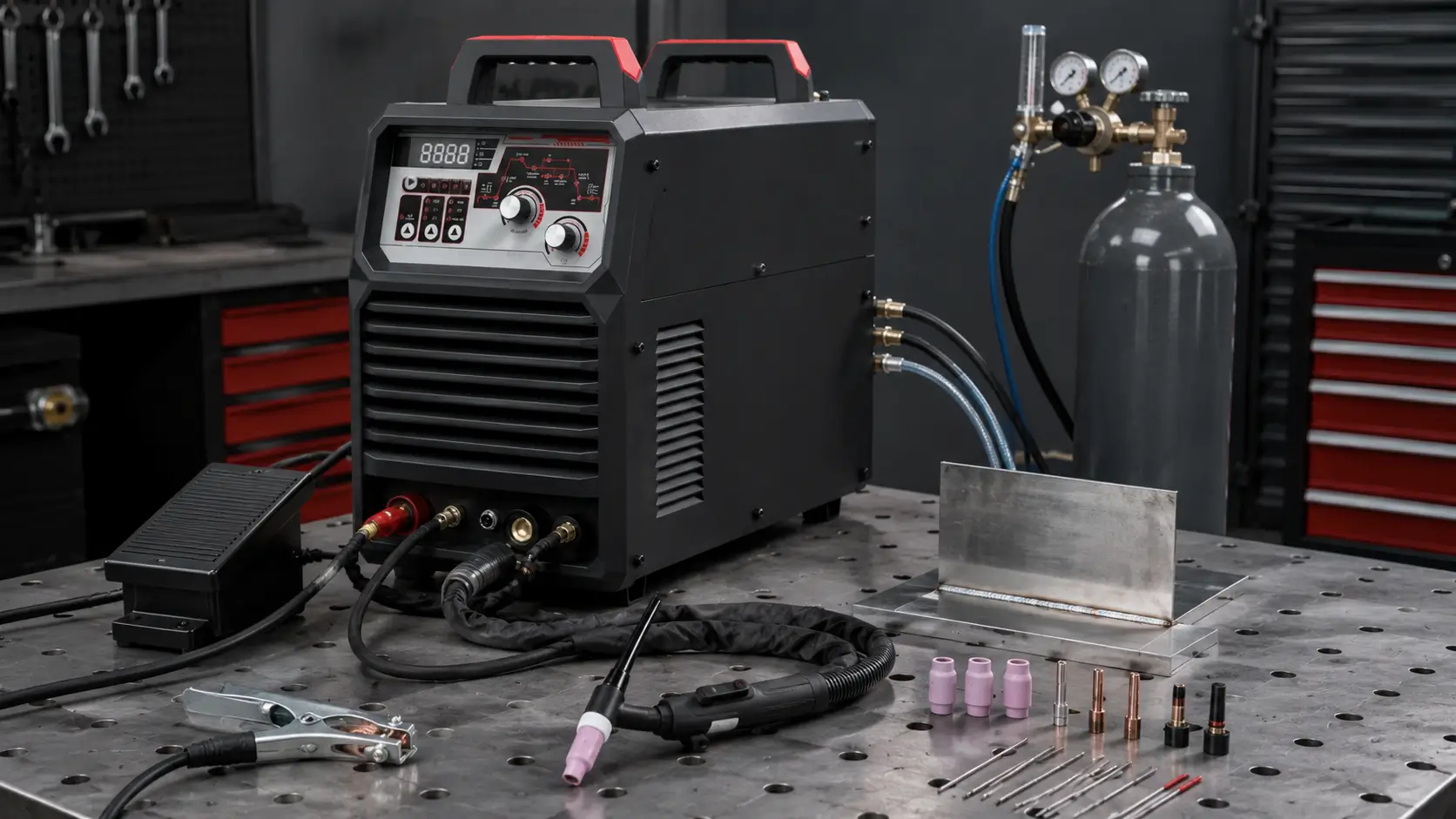
For a TIG-focused industrial welding machine, check AC/DC capability, pulse control, high-frequency start, foot pedal or remote support, water-cooled torch options, and stable low-amp control.
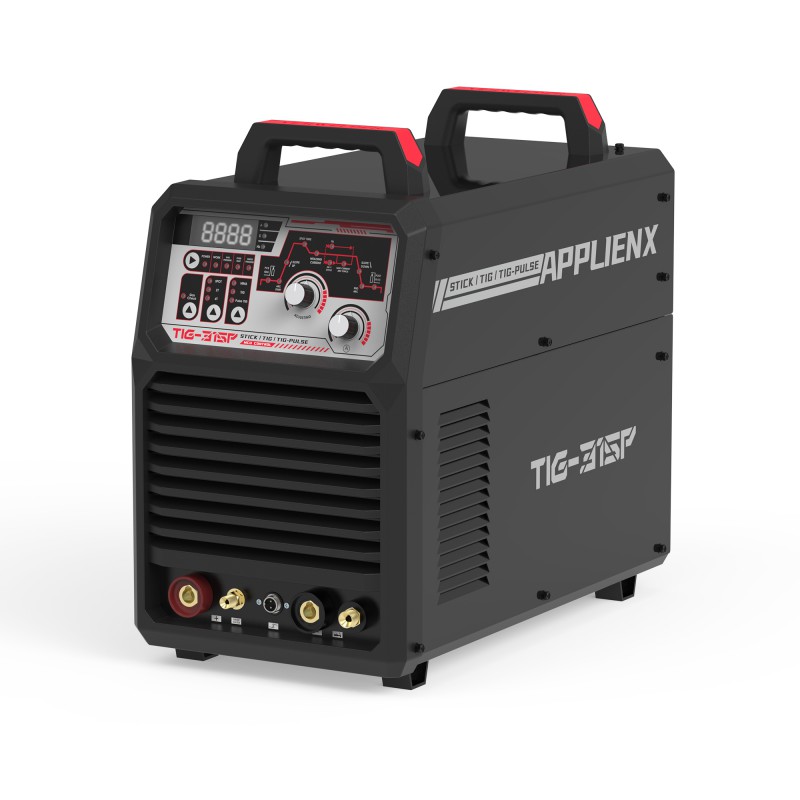
For TIG-focused industrial work, the APPLINEX TIG-315P is listed as a 315A industrial TIG welder with TIG/MMA/Pulse TIG 3-in-1 support, 3-phase 380V input, 20-315A current range, 60% duty cycle, and foot pedal or torch remote control compatibility.
Industrial Stick Welders
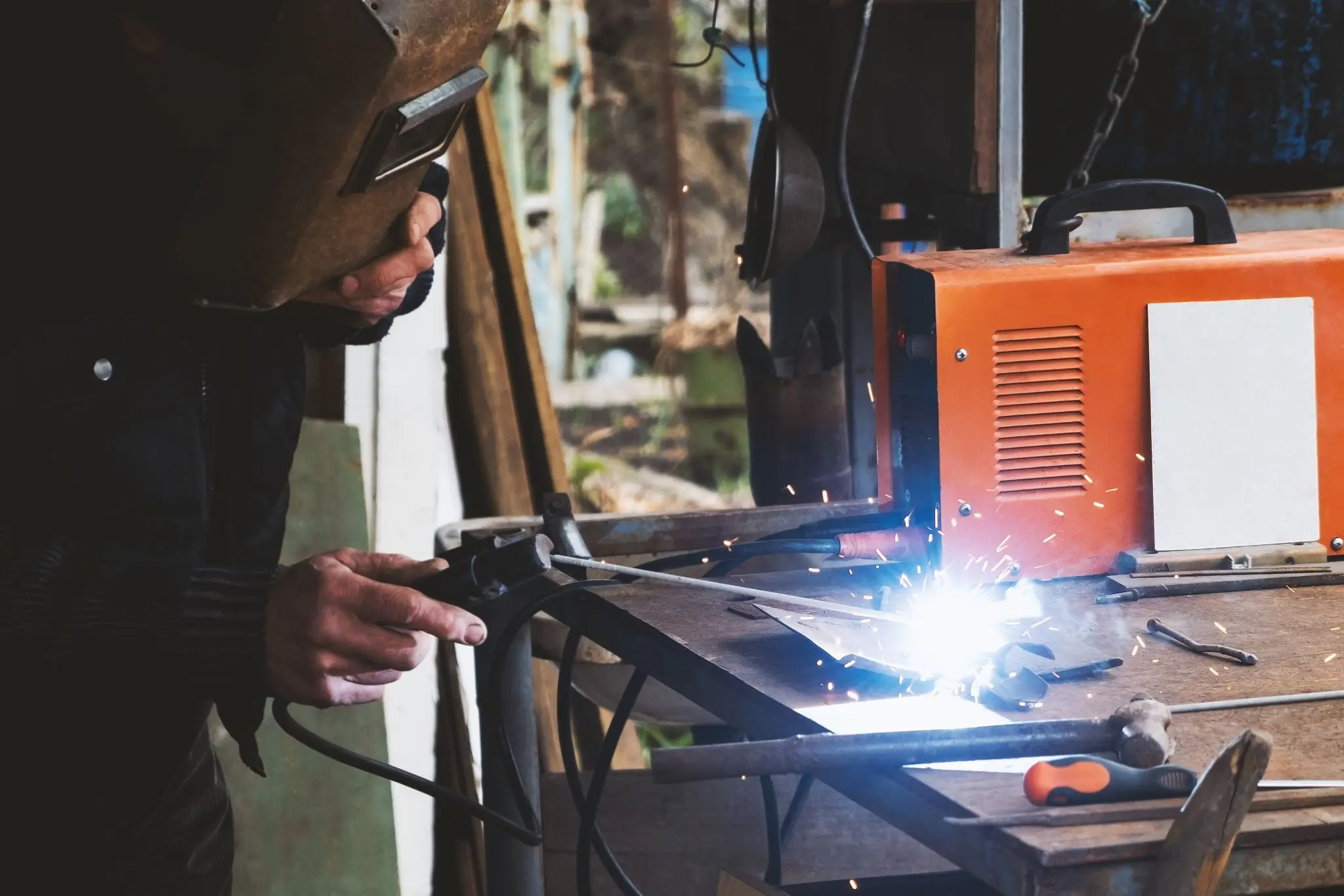
Stick welding remains important in industrial repair because it works well outdoors, tolerates rougher environments, and does not rely on wire feeding or shielding gas in the same way MIG does.
Industrial stick welders are useful for construction, heavy equipment service, field maintenance, and sites where setup needs to stay simple.
Check hot start, arc force, open circuit voltage, cable length support, generator compatibility, and amperage at the electrode size your work uses most often.
For stick welding and field repair, the APPLINEX ARC-500Q is listed as a 300A industrial stick welder with multi-voltage input, adjustable arc force, built-in hot start, and long cable support.
Multi-Process Welders
Multi-process welders support more than one process, often MIG, stick, flux-cored, and TIG variants. They make sense when a distributor, training center, repair fleet, or smaller fabrication shop wants fewer machine SKUs with broader process coverage.
Check each process separately because a multi-process machine may not have the same output rating, duty cycle, or accessory support across every mode.
A multi-process machine may cover many jobs well, but a dedicated industrial MIG system can still be the better choice for a high-volume wire-feed production line.
Engine-Driven Welders
Engine-driven welders are used where utility power is unavailable or unstable. They are common in construction, pipeline work, field repair, mining, agriculture, and remote maintenance.
For engine-driven units, compare welding output, generator output, fuel type, emissions tier, noise level, service access, trailer or truck-mount fit, and auxiliary power for grinders, lights, and tools.
On remote jobsites, welding output is only part of the decision. Generator output, fuel use, service access, and tool power can affect whether the crew can keep working.
Which Industrial Welding Machine Fits Each Application?
The best industrial welding machine depends on the work cell, material, part repeatability, and repair model.
If your team welds one repeated product, choose a machine built around that process. If your customers cover repair, training, and mixed fabrication, a balanced product line may matter more than one premium power source.
| Application | Common Machine Fit | Selection Priority |
| Structural steel fabrication | MIG, flux-cored, stick | Duty cycle, wire-feeder capacity, output range |
| Trailer and equipment manufacturing | MIG, pulsed MIG | Deposition rate, wire feeding, repeatable settings |
| Stainless fabrication | TIG, pulsed MIG | Heat control, clean arc, shielding gas setup |
| Aluminum production | AC TIG, pulsed MIG | AC control, pulse features, spool or push-pull support |
| Heavy equipment repair | Stick, MIG, engine-driven | Portability, cable length, generator fit, rugged design |
| Training centers | Multi-process | Process coverage, simple controls, consumables availability |
| Dealer product lines | MIG, TIG, stick, plasma, safety | SKU balance, support policy, spare parts, clear documentation |
What Safety and Compliance Points Matter?
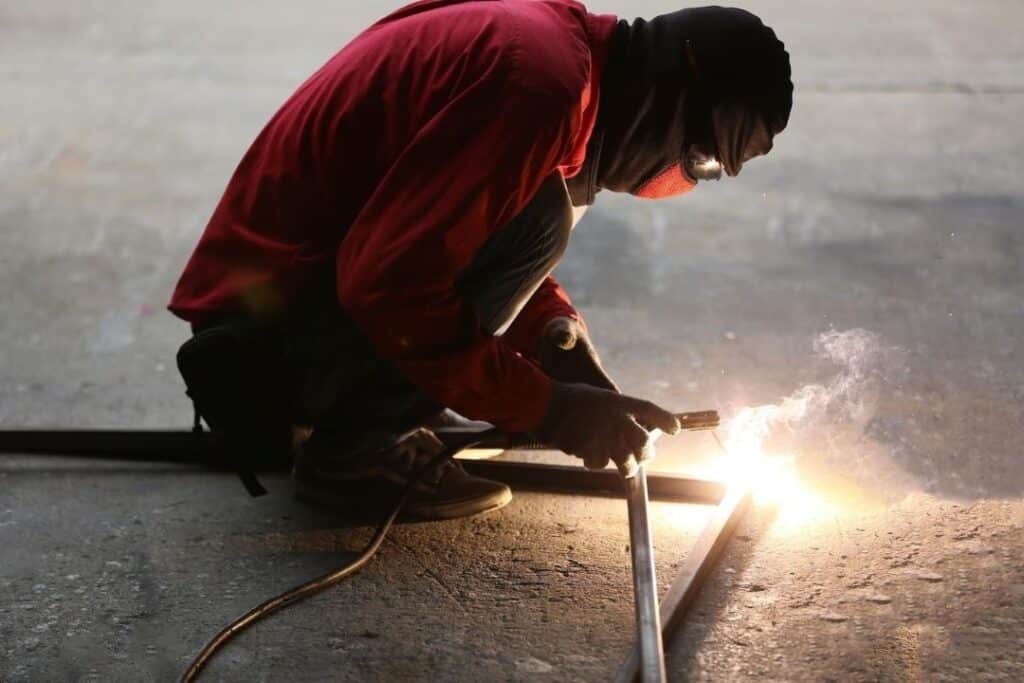
Choosing an industrial welding machine should include safety planning, not only machine comparison. Power output, arc radiation, fumes, sparks, hot work rules, and cable routing all affect shop risk.
OSHA 29 CFR 1910.252 covers general requirements for welding, cutting, and brazing in U.S. workplaces. It includes fire prevention, hot-work precautions, training responsibility, cable placement, eye protection, and restrictions around explosive atmospheres or unprepared containers.
OSHA also states that helmets or hand shields are required during arc welding and arc cutting operations.
For your operation, equipment planning should include:
- Ventilation
- Fire watch rules
- PPE
- Cable management
- Correct eye and face protection, including the right welding helmet
- Operator training
Safety requirements vary by workplace, process, and jurisdiction, so confirm the rules that apply before use.
Industrial Welding Machine Buying Checklist
A practical checklist should connect the welds you need to make with the machine specs that support them.
Start with the work, then move through power, process, accessories, safety, and support.
- List the main metals, thicknesses, and joint types.
- Identify the main process: MIG, TIG, stick, flux-cored, or multi-process.
- Record the working amperage for common jobs.
- Compare duty cycle at the working amperage, not only at maximum output.
- Confirm input voltage, phase, breaker capacity, and site power.
- Check feeder, torch, gun, cooler, clamp, and lead compatibility.
- Verify wire, electrode, gas, and consumable availability.
- Review manual, data sheet, warranty terms, and service process.
- Check safety requirements for ventilation, PPE, fire prevention, cable routing, and operator training.
- For resale, decide whether the model fits the product line and customer base.
This checklist keeps the purchase grounded in real work. It also helps dealers compare machines without reducing the decision to price and amperage alone.
How to Evaluate Industrial Welding Machine Suppliers
A good supplier should make the machine easier to compare, stock, service, and support after purchase.
Before you place a volume order or add a model to your product line, ask:
- Does the supplier provide current product data sheets and manuals?
- Are duty cycle, input voltage, and process limitations documented?
- Are torches, feeders, clamps, and consumables available in repeatable supply?
- What warranty terms apply to the whole machine and key parts?
- How are service claims handled?
- Are spare parts easy to plan, order, and replace?
- For distributors, are product images, training materials, and catalog support available?
For distributors, YesWelder Wholesale can support a broader welding equipment line across industrial MIG, TIG, stick, plasma cutting, safety gear, and welding accessories.
That helps when your customers need more than one machine type and expect repeatable consumable supply, spare parts planning, and clear product documentation.
A regional equipment dealer serving fabrication shops may prioritize industrial MIG models, while a maintenance-heavy customer base may need more stick and multi-process inventory.
Conclusion
An industrial welding machine should fit the work first. Rated output, duty cycle, input power, process support, cooling, accessories, and service support all affect whether the machine can keep up in production or repair work.
Remember these points:
- An industrial welding machine is built for higher output, longer work cycles, heavier materials, and more demanding shop or field environments.
- Duty cycle must be checked at the amperage your team actually uses.
- MIG, TIG, stick, multi-process, and engine-driven machines serve different production and repair needs.
- The right setup includes torches, feeders, coolers, consumables, spare parts, and safety planning.
- A good supplier should support documentation, warranty, repeatable parts supply, and distributor needs.
If you are comparing models for a dealer product line, YesWelder Wholesale can help review industrial MIG, TIG, stick, plasma cutting, safety, and accessory options by application, duty cycle, spare parts, and support needs.
Frequently Asked Questions
Distributors should check process fit, duty cycle, input voltage, accessory availability, spare parts supply, warranty terms, and service documentation.
A model is easier to sell and support when the specs are clear and the consumables are easy to reorder.
Start with the customer base.
Fabrication shops often need MIG or pulsed MIG models. Repair and maintenance customers may need stick or multi-process machines. Training centers usually benefit from broader process coverage and simple controls.
Spare parts affect downtime and after-sales support.
If torches, drive rolls, liners, clamps, fans, boards, or consumables are hard to replace, a good machine can still create service problems for the dealer and the end user.
Several application-specific models are usually easier to match to different customers.
One premium machine may fit a narrow production need, but a balanced line can serve fabrication, repair, training, safety, and accessory sales more effectively.
Useful documents include a product data sheet, user manual, duty cycle information, input power requirements, process limitations, parts list, warranty terms, and service process.
These materials help dealers answer customer questions before and after the sale.
Clear specs, correct application matching, available consumables, and reliable spare parts reduce the chance of returns or service disputes.
The best fit is not always the highest-amp machine. It is the machine that matches the customer’s work, power supply, duty cycle, and support needs.