Welding duplex stainless steel comes down to one thing: heat control.
Duplex gets its corrosion resistance from a 50/50 ferrite/austenite balance, and welding heat can throw that balance off fast.
Too much heat triggers sigma phase and embrittlement. Too little, and you’re left with excess ferrite and a weld that won’t hold up in service.
Whether you’re setting up for a pipe job or equipping a shop for production runs, this guide gives you the parameters and process decisions you need before you strike an arc.
What Makes Duplex Stainless Steel Challenging to Weld?
The challenge with duplex stainless steel welding comes down to metallurgical control during the weld thermal cycle, not just basic welding technique.
The weld thermal cycle constantly threatens the phase balance that makes this material worth using in the first place.
The Phase Balance Problem
During welding, the weld metal solidifies primarily as ferrite, and the nearby heat-affected zone can also become ferrite-rich during the thermal cycle. Austenite only re-forms as the joint cools through the right temperature range.
If cooling is too fast because heat input is too low, there is not enough time for enough austenite to return. The result can be an overly ferritic weld region, which reduces corrosion resistance and impact toughness.
In practice, many welding procedures aim for roughly 35–65% ferrite in the weld area. Getting close to that range is one of the main goals in duplex welding.
The Sigma Phase Risk
Too much heat input creates the opposite problem. If duplex stainless steel spends too long in the temperature range where harmful intermetallic phases can form, the weld and HAZ can lose toughness and corrosion resistance.
ASTM A923 specifically exists because duplex grades are susceptible to detrimental intermetallic compounds during exposure to roughly 320–955°C (600–1750°F).
One of the most important of these phases is sigma phase. Even small amounts can make the weld more brittle and more vulnerable to localized corrosion.
That is why duplex welding is not just about making a sound-looking bead. It is about controlling heat input, interpass temperature, and cooling behavior closely enough to preserve the microstructure that gives duplex stainless steel its value.
Which Welding Process Is Best for Duplex Stainless Steel?
No single process is best for every duplex welding job. In most cases, TIG is the better choice when root quality and heat control matter most, while pulse MIG makes more sense when section thickness and productivity matter more.
SMAW and SAW can also be used, but they usually need tighter procedure control and are less forgiving than TIG or pulse MIG.
Process Comparison at a Glance
| Process | Heat Input Control | Productivity | Typical Application | Duplex Suitability |
| TIG (GTAW) | ★★★★★ Excellent | Low–Medium | Root pass, thin pipe, precision work | Usually preferred for roots and thin sections |
| MIG (GMAW) | ★★★★☆ Good (with pulse) | High | Thick plate, production welding | Good choice when speed matters and parameters stay stable |
| Stick (SMAW) | ★★★☆☆ Moderate | Medium | Field repair, site work | Usable, but needs closer procedure control |
| SAW | ★★☆☆☆ Difficult to control | Very High | Heavy fabrication only | Mostly for specialist shop work |
TIG Welding (GTAW) — Preferred for Precision Work
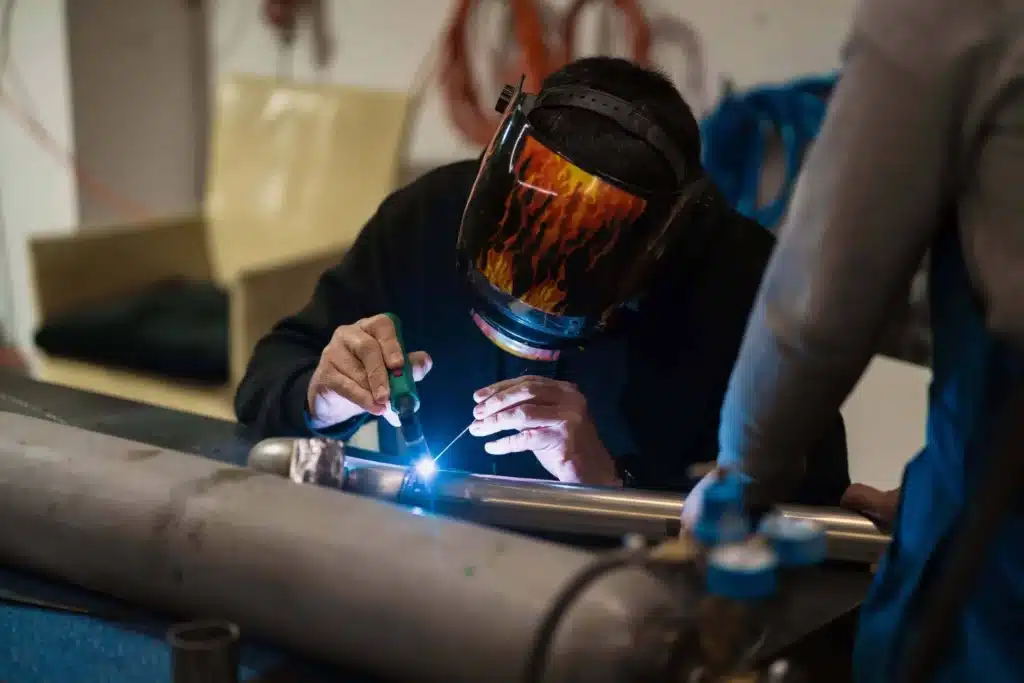
TIG is the preferred process for pipe root passes and thin-wall components. The welder has direct, real-time control over heat input, and the arc is stable enough to maintain consistent fusion without overheating the base material.
A few things are non-negotiable when TIG welding duplex pipe:
- Back purge gas is mandatory: Use 100% Ar or Ar + 2% N₂ at a flow rate of 10–15 CFH. Without it, the root bead oxidizes immediately, and that oxidized surface becomes the starting point for corrosion in service.
- Pulse TIG is the preferred configuration: Peak/background current cycling gives you precise heat input control pass by pass. For Super Duplex grades like 2507, pulse TIG isn’t optional — it’s the recommended setup.
- HF start protects weld quality: High-frequency non-contact arc starting prevents tungsten contamination of the weld pool, which is especially important on corrosion-critical applications.
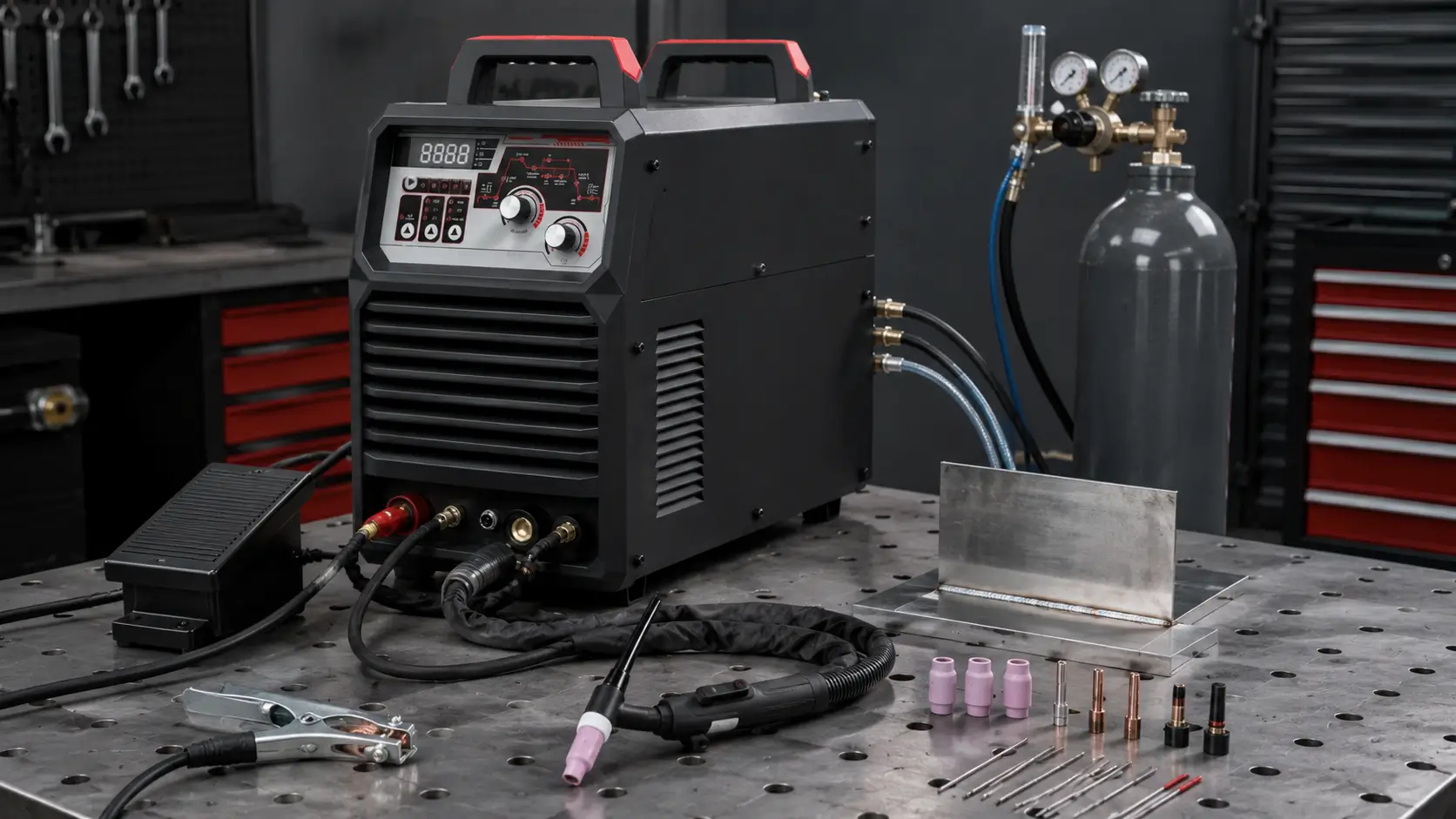
If you’re sourcing equipment for this kind of work, a wholesale tig welder with HF start, pulse capability, and 1A-resolution current control covers all the bases.
MIG Welding (GMAW) — For Higher Productivity
MIG welding makes sense for plate thicker than 6mm and production environments where throughput matters. The key word here is pulse. Standard short-circuit transfer MIG runs too cold and produces inconsistent heat input, which pushes ferrite content above the acceptable range.
Pulse GMAW keeps heat input consistent and controllable, making it a viable option for 2205 welding on heavier sections. The shielding gas matters too: use Ar + 2% N₂ rather than straight argon. The nitrogen addition stabilizes austenite formation in the weld pool and helps prevent ferrite from climbing too high.
What Are the Critical Welding Parameters for Duplex Steel?
Getting the parameters right is where duplex welding either succeeds or fails. These numbers are not suggestions.
Heat Input (The Most Critical Variable)
Heat input is calculated using this formula:
Heat Input (kJ/mm) = (Amps × Volts × 60) ÷ (Travel Speed mm/min × 1000)
The acceptable range varies by grade:
| Material Grade | Min Heat Input | Max Heat Input |
| Lean Duplex (2101/2304) | 0.5 kJ/mm | 2.5 kJ/mm |
| Standard Duplex (2205) | 0.5 kJ/mm | 2.5 kJ/mm |
| Super Duplex (2507) | 0.2 kJ/mm | 1.5 kJ/mm |
Notice how much narrower the window is for 2507. That tighter range means your welding machine needs to hold parameters consistently. Any drift in amperage or travel speed pushes you outside spec.
This is one of the main reasons Super Duplex work demands equipment with stable, precise output rather than entry-level machines.
Interpass Temperature
This is the parameter that gets skipped most often in production, and it’s also the one TWI Global identifies as the leading cause of duplex weld failures on industrial job sites. Here are the limits:
- Standard Duplex 2205: ≤ 150°C (300°F)
- Super Duplex 2507 (thin wall): ≤ 100°C (212°F)
According to TWI Global, exceeding interpass temperature limits is the leading cause of duplex stainless steel weld failures on industrial job sites. Measure with an infrared thermometer or contact pyrometer before every pass. Do not estimate by touch or by time elapsed.
Preheat Requirements
Standard duplex grades do not require preheating. This is one area where duplex is actually easier than carbon steel.
The exception is when ambient temperature drops below 5°C (41°F) or when the workpiece has surface condensation. In those cases, use a hot air gun to bring the material up to approximately 15–20°C before starting.
One important warning: do not over-preheat. Elevated starting temperatures shrink the available heat input window and accelerate sigma phase formation. Warm the part, don’t bake it.
What Filler Metals and Shielding Gases Should You Use?
For duplex stainless steel, the safest starting point is to use a matching filler metal that is slightly over-alloyed in nickel and a shielding gas that protects the weld while supporting the right phase balance.
In practice, TIG and pipe root work often use argon-based shielding and purging gases, while MIG gas selection is more procedure-dependent and should follow the wire manufacturer’s guidance and your qualified WPS.
TWI notes that duplex filler metals are typically selected with an additional 2–4% nickel to help restore austenite in the weld deposit.
Filler Metal Selection
Duplex filler metals are usually designed with slightly higher nickel content than the base material so the weld deposit can recover a better ferrite-austenite balance after dilution and cooling.
That is why matching duplex fillers are often described as over-alloyed rather than simply identical to the parent metal.
Here’s the standard selection guide:
| Base Material | Common Filler Choice | Notes | AWS Classification |
| 2205 (Standard Duplex) | ER2209 | Standard choice for most applications | AWS A5.9 |
| 2507 (Super Duplex) | ER2594 | Common choice for super duplex welds | AWS A5.9 |
| 2304 (Lean Duplex) | ER2209 | Often used where procedure allows | AWS A5.9 |
| 2101 (Lean Duplex) | ER2209 | Common practical choice, depending on WPS | AWS A5.9 |
One practical note on pipe roots: in some procedures, the root pass may use a more highly alloyed filler to help offset dilution at the root. That kind of step-up choice should be presented as a procedure-specific option, not as the default rule for every 2205 weld.
Shielding Gas Recommendations
| Application | Common Gas Approach | Typical Starting Flow Rate |
| TIG — Torch side | 100% Ar or Ar + 1–2% N₂ | 15–20 CFH |
| TIG — Back purge | 100% Ar or Ar + 1–2% N₂ | 10–15 CFH |
| MIG / GMAW | Argon-based mix; exact blend depends on wire and WPS | Follow procedure / setup |
| Stick (SMAW) | No external shielding gas | — |
Avoid high-CO₂ carbon steel gas mixes such as C25 for duplex welding. For TIG and root purging, argon-based gas is the usual starting point. For MIG, do not assume your standard carbon steel gas is suitable. Follow the filler manufacturer and your qualified WPS.
What Are the Most Common Duplex Welding Mistakes and How to Avoid Them?
The most common duplex welding mistakes are ignoring interpass temperature, using a gas setup meant for carbon steel, and skipping proper back purging on pipe roots.
All three are preventable, but all three can hurt phase balance or corrosion performance if they are ignored.
Duplex welding guides also stress interpass temperature control because duplex grades have recommended limits to reduce the risk of brittle intermetallic phases.
Mistake 1: Ignoring Interpass Temperature
Welders running back-to-back passes without measuring temperature is the most common failure mode on duplex jobs. The heat accumulates pass by pass, and by the time the fifth or sixth pass goes down, the interpass temperature is well above 200°C. Sigma phase forms, and the weld looks fine visually but fails within months in a corrosive environment.
How to avoid it: measure before every pass, no exceptions. If the part is above the limit, wait. A 10-minute cooling break is far cheaper than a failed weld in a chemical processing line.
Mistake 2: Using a Carbon Steel Gas Setup for Duplex MIG Welding
Shops that weld carbon steel and duplex on the same floor often make this mistake. Someone grabs the C25 cylinder because it’s closer, runs a few passes on a 2205 joint, and the weld looks clean. The problem shows up later under corrosion testing or in service.
Duplex MIG gas selection is not the same as carbon steel gas selection, and high-CO₂ shop mixes such as C25 should not be treated as a safe default.
How to avoid it: Do not assume your standard carbon steel gas is suitable for duplex work. Follow the filler manufacturer and your qualified WPS, and label duplex gas setups clearly in the shop.
Mistake 3: Skipping Back Purge on Pipe Welds
Skipping back purge to save setup time is a false economy. Without purge gas, the root bead oxidizes on the inside surface. This is sometimes called “sugaring.”
That oxidized layer has essentially zero corrosion resistance. In seawater service or chemical process piping, the pipe starts corroding from the inside out almost immediately.
How to avoid it: Maintain back purge flow until the weld cools below 100°C. For long pipe sections, a trailing purge dam keeps gas consumption manageable without compromising coverage.
What Equipment Do You Need for Duplex Welding?
For duplex welding, the most useful equipment is a machine that delivers stable output, good heat input control, and the process functions your procedure actually needs.
In practice, that usually means a well-controlled TIG setup for root quality and thin sections or a pulse MIG setup for thicker sections and production work.
Key Features for a Duplex TIG Welder
When TIG welding duplex stainless steel, the most helpful machine features are the ones that improve control and consistency:
- HF Non-Contact Start: Eliminates tungsten contamination at arc initiation, which matters on corrosion-critical welds where any inclusion is a problem.
- Pulse TIG Function: Peak/background current cycling is the primary tool for managing heat input pass by pass. It’s especially important on thin-wall pipe and Super Duplex grades.
- 1A-Resolution Current Control: The heat input window on 2205 is 0.5–2.5 kJ/mm. Coarse current adjustment makes it hard to stay inside that range consistently.
- Post-Flow Gas Timer: Shielding gas continues flowing after the arc stops, protecting the hot weld pool from oxidation during cooling.
Key Features for a Duplex MIG Welder
For duplex MIG welding, the goal is stable, repeatable parameter control rather than raw speed alone.
- Pulse / Double Pulse GMAW: This is the core requirement. Standard short-circuit MIG is not suitable for duplex stainless steel welding because heat input control is too imprecise.
- Synergic Control Mode: Automatically matches wire feed speed and voltage based on wire type and diameter, which reduces the risk of parameter errors during production runs.
- Stable Wire Feed: Consistent wire feed speed is the foundation of consistent heat input. Any variation in feed rate translates directly into heat input variation.
A Practical Buying Rule
If you are buying equipment specifically for duplex work, prioritize output stability, pulse capability, and consistent control over extra features that do not directly improve weld quality.
A pulse-capable machine makes it much easier to stay inside your procedure, especially in production work and on more demanding duplex grades.
While 2205 can still be welded with a non-pulse machine when pass length and cooling are managed carefully, pulse control is usually the safer and more practical choice.
For shops equipping for duplex and other precision alloy work, a wholesale mig welder with pulse and synergic functions is often the better long-term fit.
Conclusion
Duplex stainless steel welding comes down to three things: controlling heat input within the grade-specific window, selecting the right over-alloyed filler metal, and using equipment precise enough to hold parameters consistently pass after pass.
The metallurgy is unforgiving. Exceed the interpass temperature limit, use the wrong shielding gas, or skip back purge on a pipe root, and you end up with a weld that looks acceptable but fails in service. The good news is that all three of those failure modes are entirely preventable with the right process discipline and the right equipment.
For fabrication shops and contractors sourcing welding machines for duplex and specialty alloy work, YesWelder’s wholesale lineup of pulse TIG and pulse MIG welders is built for exactly this kind of precision application.
Frequently Asked Questions
No. In most cases, standard stress-relief PWHT should be avoided because the usual temperature range can promote sigma phase and other intermetallics, which make the weld more brittle. Duplex filler metals such as ER2209 and ER2594 are designed to restore phase balance during welding, so extra PWHT is usually unnecessary. The main exception is full solution annealing above 1,050°C with rapid quenching, but that is an engineering-controlled treatment, not a normal field procedure.
Yes, duplex can be welded in the field, but process control is more demanding. The main risks are moisture, low ambient temperature, and loss of shielding gas coverage from wind. Below 5°C, the joint should be warmed to prevent condensation. For pipe welding, use purge dams and verify purge oxygen is below 0.1% before welding starts.
Repairs are allowed, but they must follow the original qualified WPS. The defect must be fully removed, and the area must be cleaned back to bright metal before re-welding. Avoid carbon arc gouging because carbon pickup can reduce corrosion resistance; mechanical removal or plasma gouging is preferred. After repair, the weld should go through the same inspection steps again, including ferrite checks and, when required, ASTM A923 testing.
In general, welded duplex stainless steel is limited to about 315°C (600°F) for continuous service. Above that, long-term exposure increases the risk of intermetallic phase formation, which reduces toughness and corrosion resistance. If service temperature is regularly near or above 300°C, a nickel alloy or a high-temperature austenitic grade is usually a better choice.
Yes, significantly. Poor fit-up can force higher heat input, which can push the weld outside the acceptable range and affect phase balance. Weld sequence also matters because each pass reheats the previous one. A good sequence helps restore austenite, while a poor one can drive interpass temperature too high. Tack welds should be treated the same as production welds, because poor tacks can become corrosion initiation points.